We’re in the process of updating our site - thank you for your patience in the mean time
Why One Upholsterer Never Makes the Same Chair Twice
JournalWhy One Upholsterer Never Makes the Same Chair Twice
Two Chairs. One Pattern. Two Different Results.
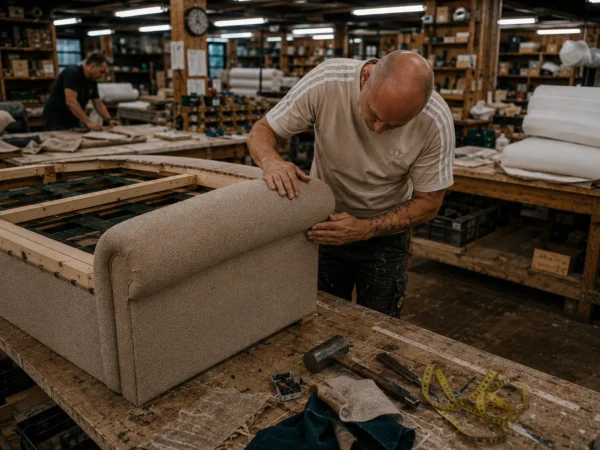
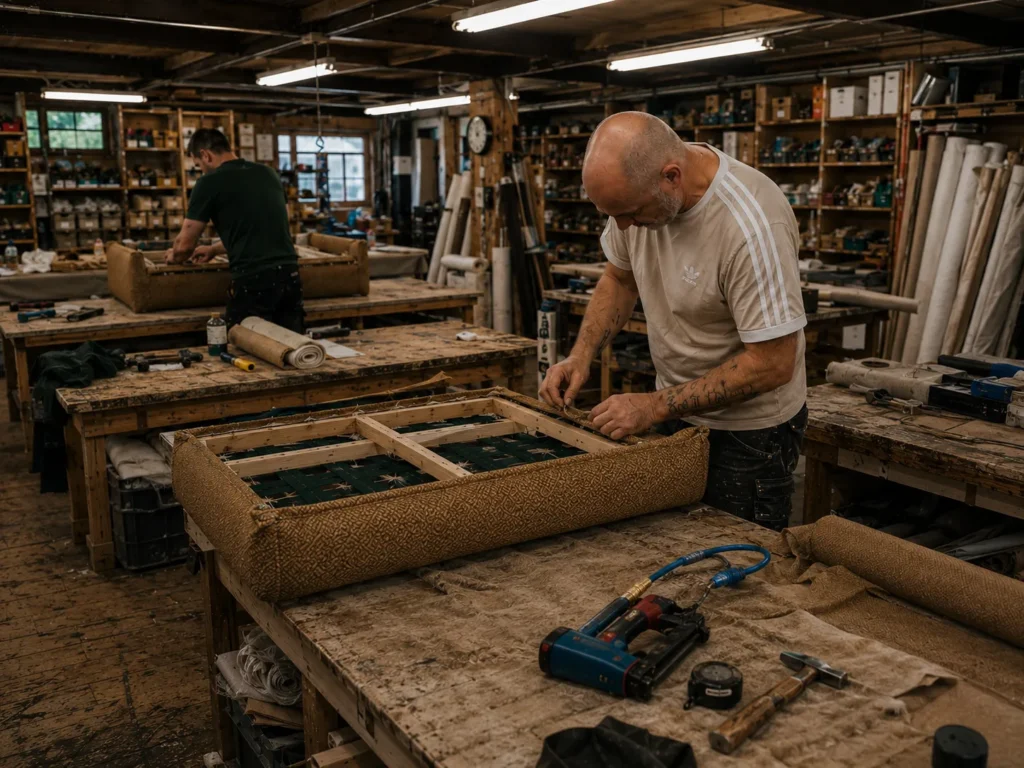
Imagine Scott Bell and Gary beginning work on exactly the same chair.
The same frame.
The same fabric.
The same pattern.
The same specification.
The same quality standards.
By the end of the day, two finished chairs stand side by side.
To most people, they are identical.
But to an experienced upholsterer, they are not.
Scott could tell you which one Gary made.
Gary could tell you which one Scott made.
Not because one is better than the other.
Both would meet John Sankey’s standards.
Both would leave the workshop.
Both would become furniture that could last for decades.
The difference is something far harder to explain.
Every upholsterer makes hundreds of tiny decisions that never appear on a drawing.
How firmly to pull the fabric.
Exactly where a pleat should sit.
How much tension feels right rather than simply acceptable.
Where an outside back naturally wants to finish.
None of those decisions are written down.
They come from experience.
Scott put it simply:
“Gary and I could each upholster exactly the same chair in exactly the same fabric, but mine would still look slightly different from his. No two upholsterers will make something in precisely the same way.”
That is the difference between manufacturing and craftsmanship.
Manufacturing repeats a process.
Craftsmanship applies judgement.
And that judgement is what quietly makes every John Sankey chair unique.
The Myth of Following Instructions
People often imagine upholstery as a process.
Follow the pattern.
Read the specification.
Complete each stage.
Move on to the next chair.
Repeat.
From a distance, it looks almost mechanical.
Scott smiles at that idea.
Because that isn’t what happens at all.
Every chair demands hundreds of tiny decisions that never appear on a production sheet.
How firmly should the fabric be pulled?
Which edge should be worked first?
How should a pleat naturally fall?
Does this corner need another fraction of tension?
Has this arm reached the point where another pull would actually make it worse?
No instruction sheet answers those questions.
They cannot.
Scott describes them simply as the countless choices that every upholsterer makes without even thinking about them anymore. Gary might begin from a slightly different point. Scott might pull the fabric a little differently. One may prepare an outside back in a subtly different way from the other. Neither is wrong. They are simply applying their own judgement.
That judgement has been built over decades.
It comes from experience rather than instruction.
Which is why two skilled upholsterers can begin with the same frame, the same fabric and the same specification and still create chairs that quietly carry the signature of the person who made them.
Judgement Lives in Small Decisions
Ask Scott what separates an average chair from an exceptional one and he doesn’t talk about better tools or better materials.
He talks about people.
“Gary and I could each upholster exactly the same chair in exactly the same fabric, but mine would still look slightly different from his.”
Those differences are almost impossible to measure.
One upholsterer may pull the fabric slightly tighter.
Another may begin from a different point.
The pleats may fall a fraction differently.
The preparation beneath the fabric may follow a slightly different rhythm.
Even the outside back may sit in a subtly different position.
None of those choices would ever be described as mistakes.
Most customers would never notice them.
Yet together they become the signature of the person who made the chair.
This is what craftsmanship really looks like.
Not dramatic moments of inspiration.
Not secret techniques.
Just hundreds of quiet decisions, made one after another, until the chair feels right.
That final phrase matters.
Not looks right.
Feels right.
Because long before an upholsterer can explain a decision, experience has already taught their hands what to do.
Twenty-Eight Years of Quiet Refinement
People often imagine experience as something dramatic.
A qualification.
A promotion.
A single breakthrough.
In reality, craftsmanship grows much more quietly.
It accumulates.
Every awkward fabric teaches something.
Every difficult frame leaves a lesson behind.
Every pattern that refuses to line up.
Every foam kit that needs adapting.
Every repair.
Every mistake remembered.
Every chair that finally comes together exactly as it should.
None of those moments seems particularly important on its own.
Together, they become judgement.
Scott has spent almost three decades making furniture. Over that time he has learned to recognise a frame that rocks before anyone else notices it. He knows when foam needs adapting rather than replacing. He checks for loose threads, hidden staples, damaged legs and dozens of other details before a chair leaves his bench. Much of that knowledge is never written down. It has simply been learned through doing the work, day after day.
The customer sees one finished chair.
The upholsterer sees every lesson that helped to build it.
Why Machines Cannot Replace This
There is a common assumption that the closer something comes to perfection, the more identical every example should become.
Machines are built around that idea.
Give them the same instruction today, tomorrow or next year, and the result should be indistinguishable.
That consistency is their strength.
Craftsmanship works differently.
A skilled upholsterer is not trying to eliminate judgement.
They are applying it.
Every chair asks small questions that no production sheet can answer.
Should this fabric be eased a little more?
Has that pleat naturally found its line?
Does this arm feel finished?
The answers come not from instructions, but from experience.
That is why two people can follow exactly the same specification and still produce work that is recognisably their own.
The difference is not inconsistency.
It is humanity.
Perhaps that is one of the reasons handmade furniture still matters.
Not because it refuses standards.
But because it refuses to replace judgement with repetition.
The Chair Becomes the Signature
A painter leaves brushstrokes.
A musician leaves phrasing.
A writer leaves a voice.
An upholsterer leaves something quieter.
There is no signature hidden beneath the fabric.
No name stitched into the frame.
Instead, the signature is written into the chair itself.
In the way the fabric settles.
In the confidence of a line.
In the countless tiny decisions that nobody notices individually, but everybody somehow feels together.
Most customers will never be able to explain why one handmade chair feels different from another.
Another upholsterer probably could.
Because they would recognise the thing that cannot easily be measured.
Judgement.
That quiet individuality is one of the reasons handmade furniture has character.
Not because every chair is different.
But because every chair has been understood by the person who made it.
Editorial Conclusion
Perhaps the greatest misunderstanding about craftsmanship is the belief that excellence comes from making everything exactly the same.
It doesn’t.
It comes from knowing when something is right.
Scott and Gary could upholster the same chair, using the same frame, the same fabric and the same specification.
Both chairs would meet the same standard.
Both would leave the workshop.
Yet each would quietly reveal the person who made it.
Not because either upholsterer ignored the process.
Because each has spent nearly three decades learning how to interpret it.
The finest handmade furniture is never anonymous.
It carries, in ways that are almost impossible to describe, the judgement of the person whose hands brought it into being.
And perhaps that is what we are really recognising when we say that a piece has something about it.