The Knowledge Held in the Hand
There are some kinds of knowledge that cannot be written into a manual.
You cannot learn them from a specification.
They are learned slowly.
Through repetition.
Through mistakes.
Through thousands of ordinary working days.
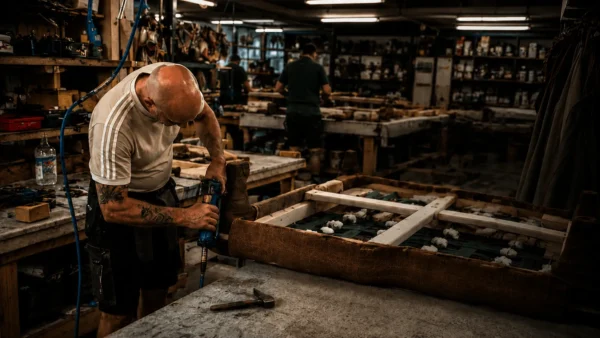
This week I spent time in our upholstery workshop, watching Scott Bell work.
At first glance, very little seemed to happen.
A staple was fired.
A piece of fabric was pulled into place.
A hand paused for a moment before making its next movement.
Nothing dramatic.
Nothing designed to impress.
And yet, the longer I watched, the more I realised I wasn’t really watching upholstery.
I was watching judgement.
We often talk about knowledge as though it lives in books, qualifications or instructions.
But some knowledge chooses a different home.
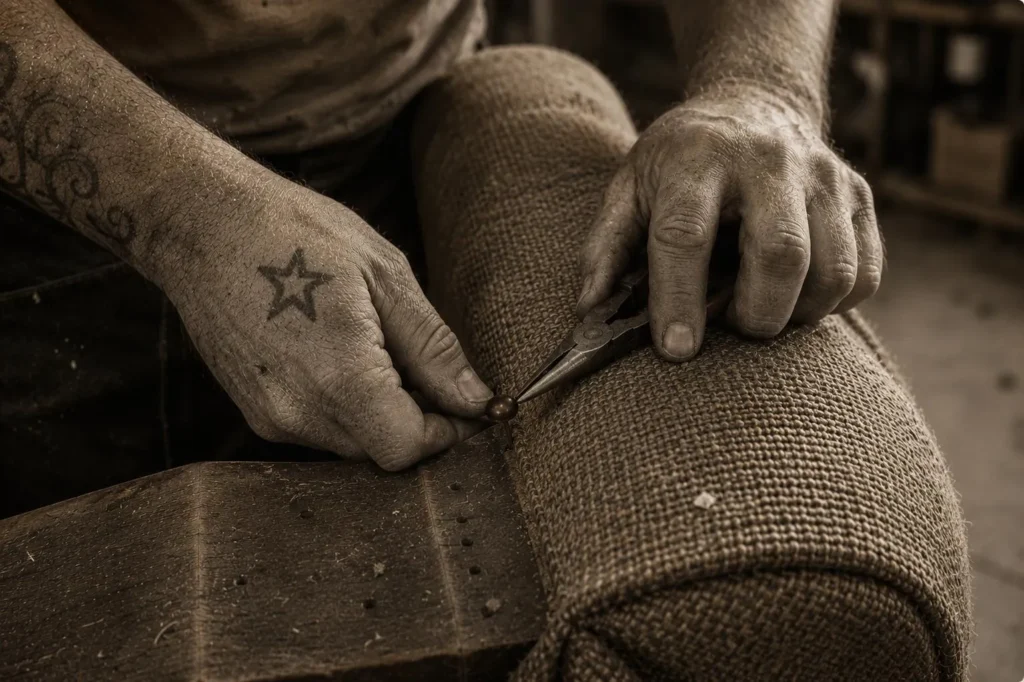
It settles into a person’s hands.
After enough years, those hands begin to notice things that others never see.
A frame that isn’t sitting quite true.
A pleat that wants to fall differently.
A little more tension here.
A little less there.
None of those decisions appear on a drawing.
Most customers will never know they were made.
But they are the reason the finished chair feels exactly as it should.
That struck me because we live in a world that increasingly celebrates information.
Information has never been easier to find.
Almost anything can be looked up in seconds.
But judgement is different.
Judgement cannot be downloaded.
It cannot be hurried.
It is earned.
One decision at a time.
One mistake at a time.
One ordinary day after another.
The workshop reminded me that craftsmanship isn’t really about making furniture.
It is about learning to see.
Scott looks at a finished chair and immediately notices everything that came before it.
He sees the frame before the fabric.
The preparation before the presentation.
The hidden work before the visible result.
Most of us admire what we can see.
The craftsman worries about what nobody ever will.
Perhaps that is why the finest workmanship often disappears completely.
When something has been made properly, nothing asks for attention.
The chair simply feels comfortable.
The sofa simply belongs.
The owner never thinks about the thousands of decisions hidden beneath the upholstery because the craftsman has already done that thinking for them.
Good work has a curious ambition.
It wants to become invisible.
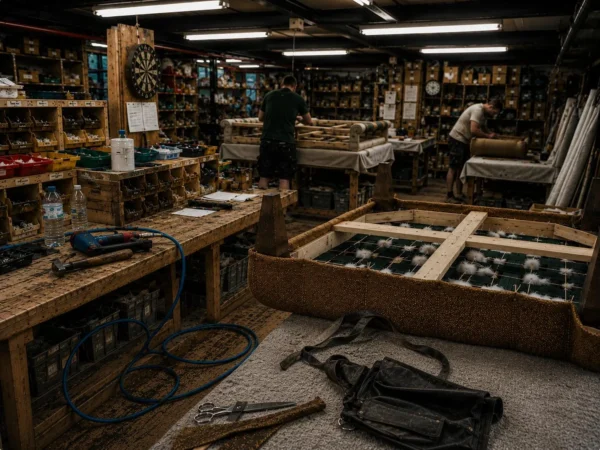
As I walked around the workshop, I noticed something else.
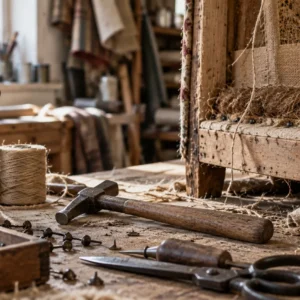
An old hammer hanging within easy reach.
It has been there for twenty-six years.
Nobody displays it.
Nobody talks about it.
Every morning someone simply reaches for it and carries on working.
That struck me as rather beautiful.
Not because the hammer is old.
But because it is still useful.
Its history has never been preserved in glass.
It has been preserved in purpose.
Then there was another story.
Scott told me about collecting an old chair that he thought was worth about fifty pounds.
When he met its owner and realised she had lived with it for more than fifty years, he stopped seeing an old chair.
He started seeing fifty years of someone’s life.
In that moment he stopped thinking like an upholsterer.
He started thinking like a custodian.
That, perhaps more than anything else, explains what craftsmanship really is.
It isn’t simply the ability to make.
It is the wisdom to recognise what deserves preserving.
The more time I spend around the people who make John Sankey furniture, the less I believe we are really in the furniture business.
Of course we make chairs and sofas.
But underneath all of that, something else is happening.
People are quietly passing judgement from one generation to the next.
Knowledge that has moved from experienced hands into younger ones.
Ways of seeing that cannot easily be explained, only demonstrated.
It is slow work.
Patient work.
Human work.
And perhaps that is precisely why it still matters.
In an age that celebrates speed, the workshop reminds us that some things simply refuse to be rushed.
Experience.
Trust.
Judgement.
They all arrive in exactly the same way.
Quietly.
Over time.
One ordinary day after another.
Perhaps that is why handmade furniture still feels different.
Not because every chair is unique.
But because every chair carries something that no machine can ever manufacture.
The accumulated judgement of the person who made it.
And I suspect that, long after fashions have changed, that will still be one of the most valuable things any craftsman can leave behind.