Twenty-Eight Years Learning What Most People Never Notice
Learning to See
Most of us look at a finished chair.
Scott looks at everything that came before it.
Before he notices the fabric, he notices the frame.
Before he notices the shape, he notices whether it sits perfectly flat.
Before he thinks about how a chair looks, he is thinking about how it will feel in ten years’ time.
It is a different way of seeing.
The sort of seeing that only arrives after thousands of hours at an upholstery bench.
The sort of judgement that cannot be written into a manual or measured with a ruler.
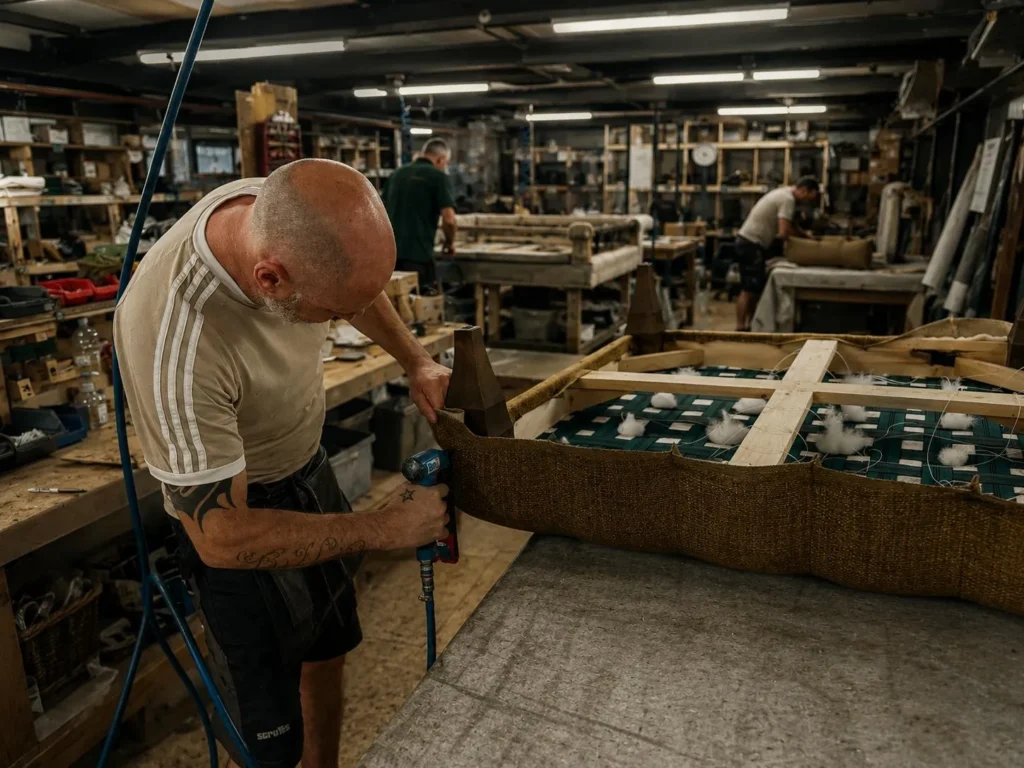
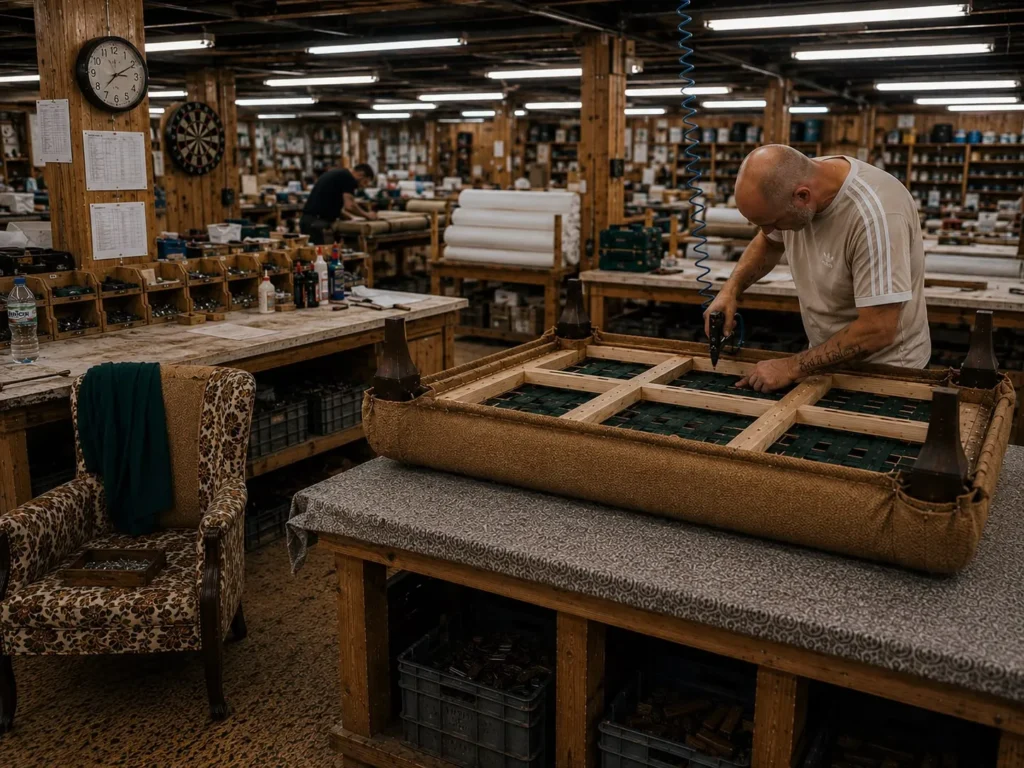
Spend a few minutes watching Scott work and something becomes obvious.
He is rarely rushing.
His hands move with the quiet confidence of repetition.
A staple is checked before the next one is fired.
The fabric is pulled almost instinctively.
Every movement seems ordinary until you realise how many decisions are hidden inside it.
Ask him what people misunderstand about upholstery and he doesn’t talk about hard work.
He talks about memory.
The different spring sizes.
The clips.
The foam densities.
The countless combinations that have to be remembered before a single piece of fabric is stretched across a frame.
To most people, a sofa is something you buy.
To Scott, it is hundreds of invisible decisions that nobody will ever see.
Perhaps that is why he has stayed with upholstery for nearly three decades.
Not because every day is different.
But because every chair is.
Two upholsterers can begin with the same frame.
The same fabric.
The same specification.
And still produce something subtly different.
The difference is experience.
The difference is judgement.
The difference is seeing what most people never notice.
That is why Scott is worth meeting.
Not because he has spent twenty-eight years making furniture.
Because he has spent twenty-eight years learning how to see it.
Twenty-Eight Years Learning the Craft
Scott never planned to spend almost three decades making furniture.
At school, when the time came to choose a work-experience placement, he already knew one thing about himself. He enjoyed making things. Practical work came naturally, so he spent his placement at Raleigh, building bicycles. It was an early indication that satisfaction, for him, would always come from working with his hands.
Upholstery arrived almost by chance.
Friends were already working at Charnwood and asked if he wanted to join them. He did. There was no grand career plan or lifelong ambition to become an upholsterer. There was simply an opportunity to learn a trade. Twenty-eight years later, he is still doing it.
“It just stuck,” he says.
The trade itself became his education.
When Scott first arrived at John Sankey in 1998, he learned from experienced upholsterers who had spent years refining their craft. He remembers Phil Froggett, brothers Paul and Carlton Cavers and Ian Farmer. Ian’s dad was one of the original upholsterers who helped form John Sankey in 1953!
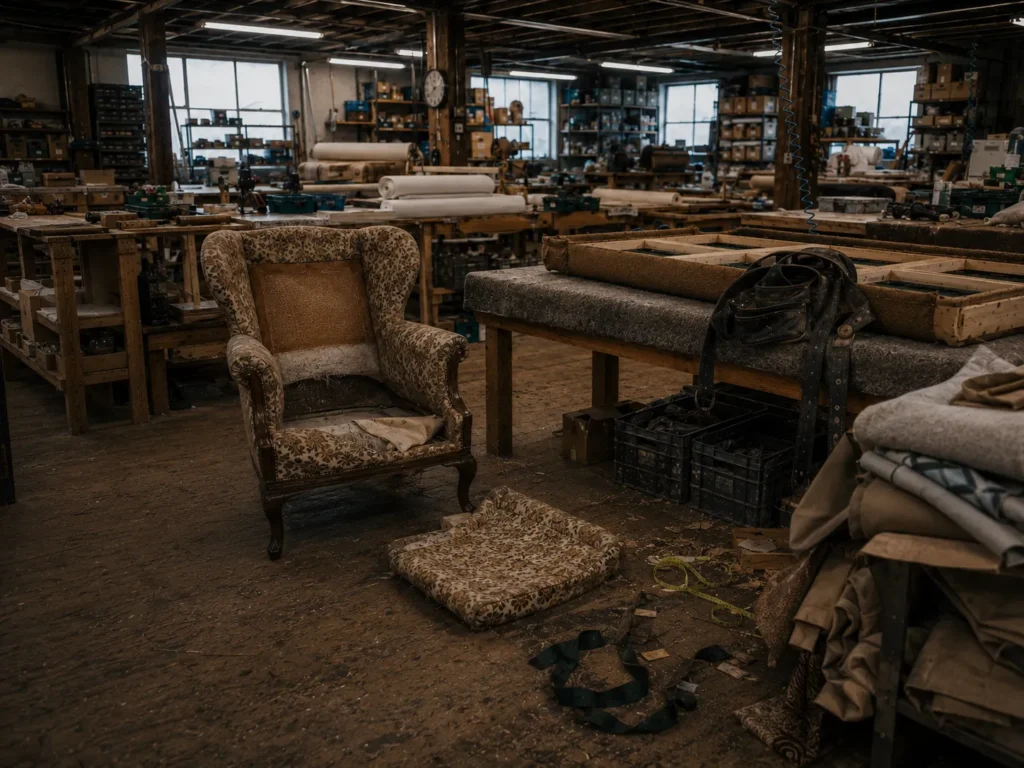
He also remembers the workshop itself. In those days, the factory was organised into smaller working rooms where cutters, machinists and upholsterers worked side by side. If something wasn’t quite right, it could be passed back immediately. Knowledge travelled across the room as naturally as the furniture itself.
Looking back, it wasn’t one individual who taught him. It was years of repetition, quiet observation and the willingness to keep learning.
So what kept him there?
His answer isn’t about earning a living or becoming faster at the job.
“It’s craftsmanship,” he says. “Somebody may own what you make for the rest of their life, especially if it’s a good chair. I feel proud of that.”
That pride explains why one-off pieces remain his favourites. Unlike mass-produced furniture, every unusual fabric, every difficult pattern and every bespoke commission demands something new from the person making it. Each piece asks another question of the craft, and after twenty-eight years Scott is still interested in discovering the answer.
Perhaps that’s the real story.
Not that Scott has spent twenty-eight years making furniture.
But that he has spent twenty-eight years learning a craft that never completely stops teaching the people willing to practise it.
The Things Experience Notices
Experience rarely announces itself.
It doesn’t arrive with a certificate or a title. More often, it quietly changes what a person notices.
Stand beside Scott while he examines a furniture frame and he will see things that most of us never think to look for.
Before any fabric is stretched into place, he wants to know whether the frame sits perfectly flat. A slight movement, barely noticeable to anyone else, tells him something isn’t quite right. On a carpet, it might never be detected. On a level workshop floor, experience catches it immediately.
That ability isn’t eyesight.
It’s judgement.
Ask Scott what people misunderstand about upholstery and he doesn’t begin with fabrics or tools. He talks about memory.
Every piece demands hundreds of decisions before the customer ever sees it. Different spring sizes. The correct number of clips. Foam densities. Whether every part of the foam kit is present. Layers of knowledge that have become so familiar they now feel instinctive.
Those are the things experience remembers so that the hands can keep working.
It also changes the way mistakes are seen.
An apprentice may notice a loose staple or a thread that has escaped attention. Scott notices those too. But years at the bench have taught him to look further back through the process. If a frame has been twisted, if a joint hasn’t been glued correctly or if the preparation beneath the upholstery isn’t right, the problem may remain hidden until long after the furniture is finished. By then, correcting it is no longer simple.
That is why craftsmanship can never become a checklist.
Two upholsterers can begin with the same frame, the same fabric and the same specification, yet the finished chairs will still carry the fingerprints of different judgement. Tiny decisions, almost invisible on their own, quietly accumulate until they become the difference between ordinary work and exceptional work.
Perhaps that is what twenty-eight years really teaches.
Not simply how to make furniture.
But how to notice the things that everyone else walks past.
Why Every Chair Is Different
There is a temptation to think that making furniture is simply a matter of following instructions.
The same frame.
The same fabric.
The same measurements.
The same specification.
Surely the result should always be identical.
Scott smiles at the idea.
“Gary and I could each upholster exactly the same chair in exactly the same fabric, but mine would still look slightly different from his.”
“No two upholsterers will make something in precisely the same way. You might pull the fabric differently. Your pleats, preparation or the positioning of the outside back may be slightly different. Exceptional work is built from all those small decisions.”
Those differences aren’t mistakes.
They are judgement.
One upholsterer may apply a little more tension through the fabric. Another may instinctively soften a corner by the smallest amount. One pair of hands pauses for a fraction longer before fixing the final edge into place. None of those decisions appear on a drawing. They come from experience, confidence and the quiet habits developed over thousands of hours at the bench.
It is easy to assume that craftsmanship is about precision.
In reality, it is about consistency of judgement.
The specification tells an upholsterer what the chair should become.
Experience decides how to get it there.
That is why handmade furniture retains something that cannot be replicated by a production line.
Every chair carries the accumulated decisions of the person who made it.
Not dramatic decisions.
Not visible decisions.
Hundreds of tiny judgements that nobody notices individually, yet which quietly shape the finished piece.
Perhaps that is why two handmade chairs can never be completely identical.
They are built from the same materials.
But they are guided by different eyes, different hands and different lives.
The furniture may leave the workshop looking remarkably similar.
The judgement that created it is entirely unique.
Furniture That Lives Longer Than Fashion
Ask Scott what has kept him in upholstery for nearly three decades and he doesn’t begin by talking about techniques or tools.
He talks about what happens after the furniture leaves the workshop.
“It’s craftsmanship,” he says. “Somebody may own what you make for the rest of their life, especially if it’s a good chair. I feel proud of that.”
It is a simple answer, but it reveals a very different way of thinking about furniture.
In a world where so many things are designed to be replaced, an upholsterer works with the hope that what he makes will remain. That it will become part of a family’s everyday life. That it will witness conversations, celebrations, quiet evenings and ordinary mornings. That years from now it will still be doing the job it was built to do.
Making something properly is therefore not about perfection.
It is about respect.
Respect for the materials. Respect for the person who will eventually own it. Respect for the years the furniture has yet to live.
That is one of the reasons Scott enjoys making one-off pieces more than anything else. Every unusual fabric, every complex pattern and every bespoke commission asks a little more of the craftsman. It is slower work, more demanding work, but it is also work that rewards patience and care.
Perhaps that is why furniture made by hand feels different.
Not because every stitch is visible.
Not because every detail demands attention.
But because the person making it has already imagined the decades that might lie ahead.
Fashion asks what people will want this season.
Craftsmanship asks what they will still value in thirty years’ time.
The Quiet Satisfaction of Getting It Right
For most people, the work ends when the chair looks finished.
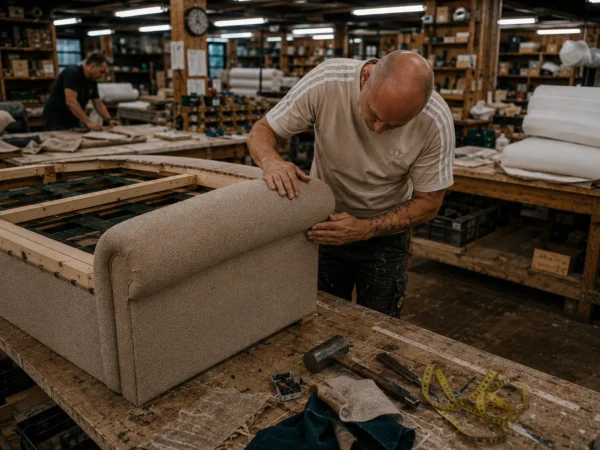
For Scott, that is when the checking begins.
He runs his hands across the fabric, feeling for anything the eye might miss. He checks that every button is secure, every staple hidden, every thread trimmed away. He looks for scratches on the legs, imperfections in the finish, anything that might disturb the experience of the person who will one day own it.
It is a quiet ritual, repeated at the end of every piece.
Not because someone is watching.
Because it matters.
The strange thing about good upholstery is that success is almost invisible.
If the fabric sits perfectly, nobody comments on it.
If the pattern flows effortlessly around the chair, it feels as though it was always meant to be that way.
If the frame is solid, the seat comfortable and every detail in harmony, the customer simply enjoys the furniture without ever thinking about the thousands of decisions that made it possible.
That is the reward.
Not applause.
Not recognition.
But the knowledge that nothing distracts from the finished piece because nothing has been left to chance.
Perhaps that is the paradox of craftsmanship.
The better the work, the less people notice the work itself.
All they notice is how the chair feels to live with.
For Scott, after twenty-eight years at the bench, that quiet satisfaction is more than enough.
Twenty-Eight Years Later
After twenty-eight years, it would be easy to imagine that the work had become routine.
It hasn’t.
Scott still enjoys the challenge of making something different. An unusual fabric. A complex pattern. A chair that asks a little more of the person making it. Those are the pieces he remembers. The ones that demand patience, concentration and the confidence that only experience can bring.
He still enjoys coming into the workshop.
Not simply because of the furniture, but because of the people. Workshops are built on shared knowledge, quiet conversations and the rhythm of working alongside others who understand the craft. There is satisfaction in making something well, but there is also satisfaction in belonging to the small community that makes it possible.
When asked what he hopes John Sankey is still known for in another fifty years, his answer is as much about preservation as progress. Furniture trends will continue to change. New fabrics will appear. New designs will emerge. But the principles behind good furniture should remain exactly as they are today.
Make it properly.
Take pride in it.
Build something that deserves to last.
Perhaps that is what British furniture making has always been at its best.
Not the pursuit of novelty, but the pursuit of quality.
Not furniture designed for a season, but furniture designed for a lifetime.
Twenty-eight years after he first picked up the tools of the trade, Scott is still learning, still refining and still taking pride in work that most people will never fully see.
Perhaps that is the highest compliment a craftsman can receive.
That the furniture speaks so completely for itself that nobody ever has to think about the hands that made it.
Editorial Conclusion
Most of us judge furniture by what we can see.
The shape.
The fabric.
The colour.
How comfortable it feels the first time we sit down.
Scott has spent twenty-eight years learning to notice something entirely different.
The things hidden beneath the fabric.
The tiny decisions made before the first stitch.
The details that disappear long before the chair reaches someone’s home.
Those are the things that determine whether a piece of furniture simply looks good today, or quietly earns its place in a family’s life for decades to come.
Perhaps that is the real craft.
Not making something that attracts attention.
But making something that continues to deserve it, year after year.
The finest upholstery is rarely the work you notice most.
It is the work you never have to think about at all.