A beautifully upholstered chair has a way of convincing us that it has always existed exactly as we see it.
The lines feel effortless.
The fabric falls naturally into place.
Every curve appears inevitable.
Nothing asks for attention.
Nothing hints at the hundreds of decisions that brought it into being.
That is the beautiful lie.
The finest furniture gives the impression that it simply arrived, complete and resolved, waiting patiently for someone to bring it home.
It didn’t.
Long before the fabric was chosen, someone had already judged the frame. They had checked that it sat perfectly true, selected the correct springs, prepared the arms, shaped the foam, corrected imperfections and quietly solved problems that the finished chair would never reveal.
When the work is done well, almost all of it disappears.
The customer never sees the hidden structure. They never notice the preparation beneath the upholstery or the countless checks made before the furniture leaves the workshop.
Instead, they experience only the result.
That is the paradox of craftsmanship.
The better the furniture, the less it tells you about the work that made it possible.
The Things Hidden Beneath the Fabric
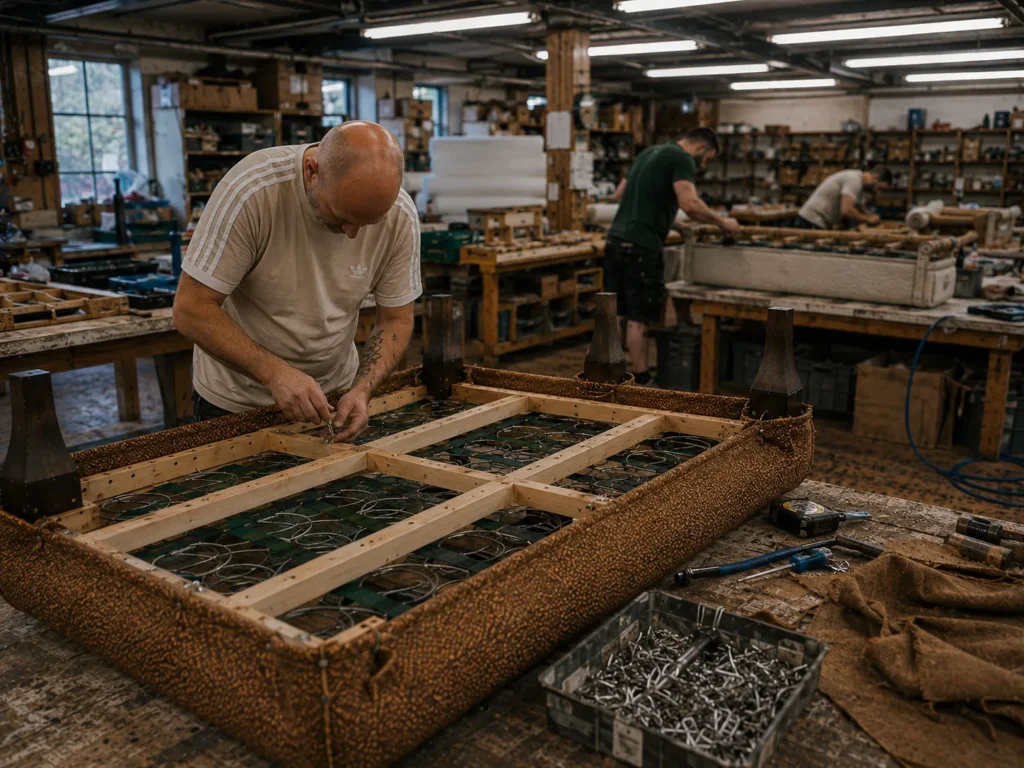
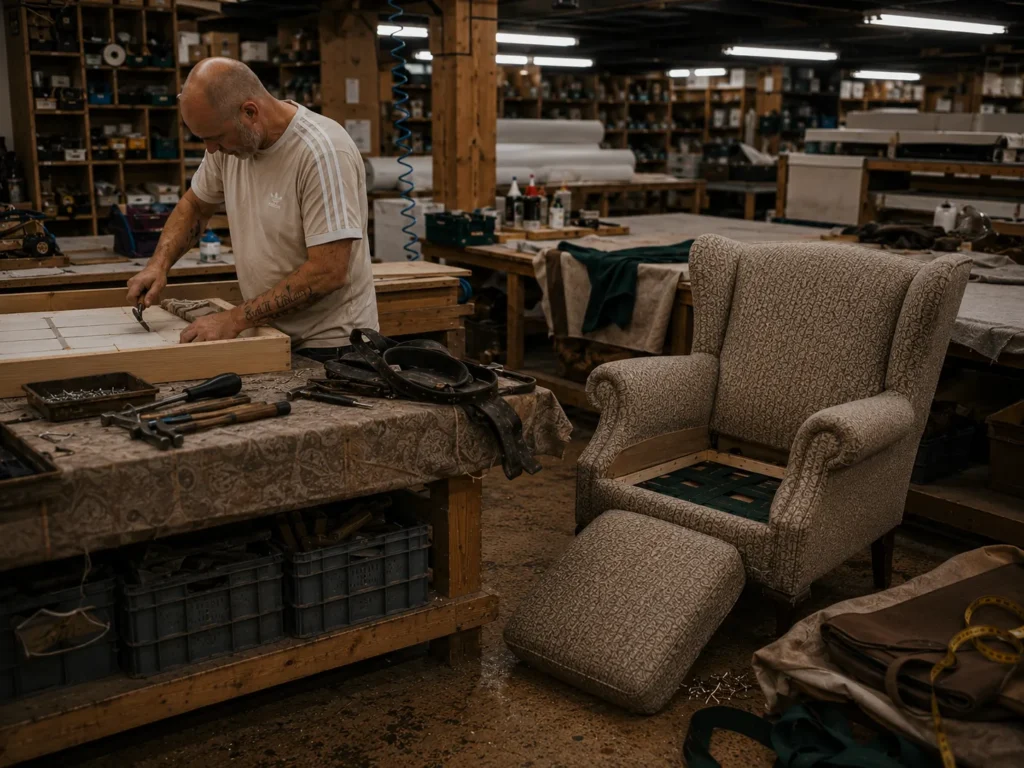
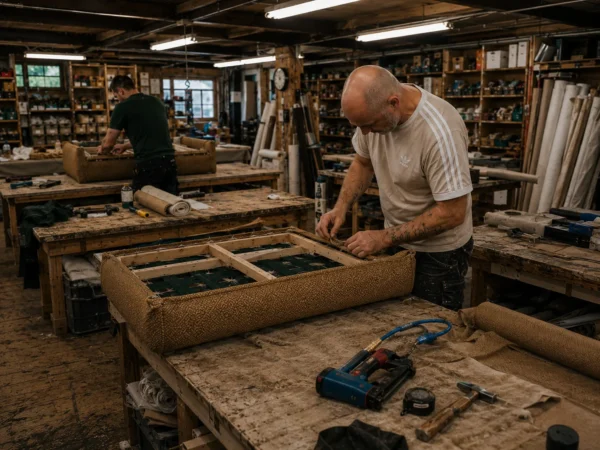
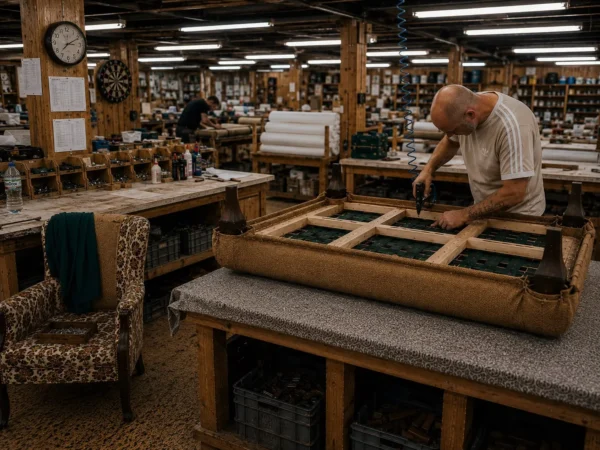
Strip away the fabric from a beautifully upholstered chair and something unexpected happens.
It becomes less beautiful.
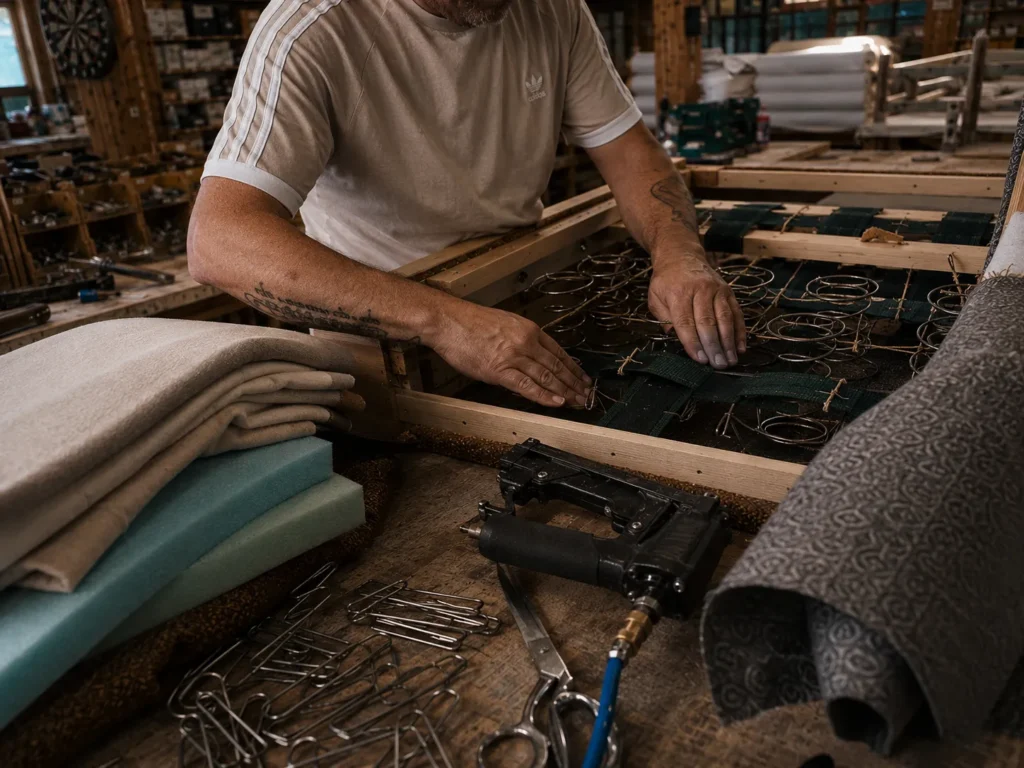
Springs stretch across the frame.
Webbing disappears beneath layers of padding.
Foam of different shapes and densities begins to emerge.
Timber, staples, clips and hidden joints reveal themselves one by one.
To an untrained eye, it can appear surprisingly ordinary.
And yet this hidden world is where the chair is truly made.
Scott laughs when people underestimate upholstery. Most people see the finished fabric. He sees spring sizes, clip positions, foam densities and the preparation beneath the arms. Years of experience have taught him that these invisible details determine whether the finished furniture will feel right, remain quiet and continue to perform long after it has left the workshop.
The irony is that the better this work is done, the less anyone will ever notice it.
Nobody sits down and admires correctly tensioned webbing.
Nobody comments on perfectly chosen foam densities.
Nobody sees the preparation hidden beneath the upholstery.
Instead, they simply notice that the chair feels comfortable. That it sits properly. That it remains supportive. That, ten or twenty years later, it still feels much as it did the day it arrived.
That is what great upholstery really delivers.
Not something to look at.
Something to live with.
Everything hidden beneath the fabric exists for one purpose: to create an experience so effortless that the owner never has to think about the craftsmanship concealed inside.
The First Thing Scott Looks For
Most people begin by looking at the fabric.
Scott begins with the frame.
Before a single spring is fitted or a piece of foam is lifted into place, he places the frame on a hard, level floor.
Then he tries to rock it.
It seems like an insignificant test.
It isn’t.
A frame that rocks, even slightly, is telling him that something isn’t quite right. Somewhere within the timber, there may be a twist. On a carpet, the problem might never be noticed. The softness beneath your feet disguises it. In the workshop, on a flat concrete floor, experience catches it immediately.
The frame is speaking.
Scott has simply spent long enough learning its language.
That ability cannot be found on a specification sheet.
It isn’t measured with a tape measure or recorded on a production drawing.
It is judgement.
An apprentice might see a perfectly good frame, ready for upholstery.
An experienced upholsterer sees a question that still needs answering.
If the foundation is wrong, everything built upon it will inherit the problem. Fabric can disguise it. Cushions can soften it. But they can never truly correct it.
That is why craftsmanship begins long before the visible work.
Long before the fabric is stretched into place.
Long before the chair begins to resemble the piece that will eventually stand in someone’s home.
The finest upholsterers are not simply skilled at making furniture.
They are skilled at recognising the small imperfections that everyone else walks past—and quietly putting them right before anyone else ever knows they were there.
Thousands of Decisions Nobody Notices
It is easy to imagine that upholstery is repetitive work.
The same chair.
The same fabric.
The same sequence of steps.
Repeat.
Repeat.
Repeat.
Scott knows it doesn’t work like that.
Every piece begins with a series of questions.
Are the spring clips correct?
Does the frame sit exactly as it should?
Is every section of the foam kit present?
Is the density right for this particular piece?
Has the preparation beneath the arms been completed properly?
Has every hidden joint been checked before the upholstery conceals it forever?
None of these decisions are visible once the chair is finished.
Every one of them affects how it will feel to live with.
Sometimes the answer isn’t straightforward. A foam section may arrive slightly undersized. A component may need adapting before work can continue. An inexperienced upholsterer might stop and wait for a replacement. Experience asks a different question.
How do you achieve the correct result without compromising the finished piece?
That is where craftsmanship lives.
Not in following a process.
But in making hundreds of small judgements that preserve the standard of the furniture.
The same thinking continues until the very end.
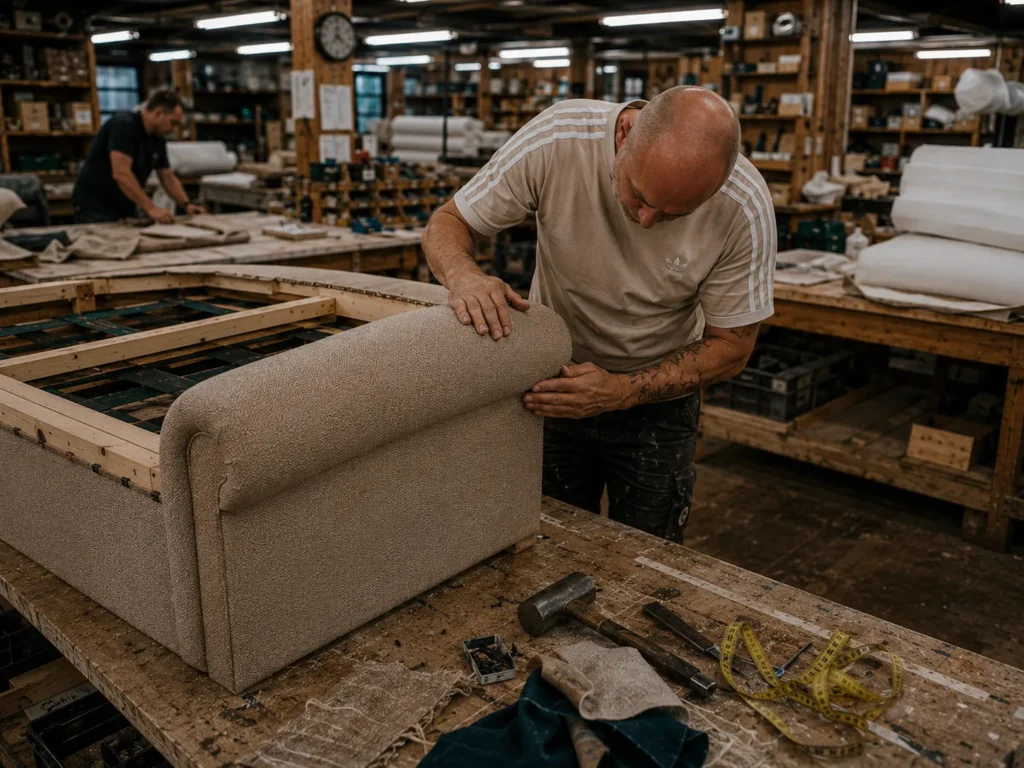
Scott checks that every staple has disappeared beneath the fabric. That every button is secure. That there are no loose threads, no scratches on the legs and nothing that would betray the care that has gone into the piece.
Then another upholsterer checks it again.
Not because mistakes are expected.
Because quality is never assumed.
Perhaps that is the greatest misunderstanding about handmade furniture.
People imagine it is built by following instructions.
In reality, it is built by making decisions.
Hundreds of them.
Most are forgotten within minutes.
All of them remain inside the finished chair.
When Good Work Disappears
There is a curious paradox at the heart of craftsmanship.
The better the work, the less anyone notices it.
Nobody admires a perfectly hidden staple.
Nobody talks about straight webbing beneath the seat.
Nobody comments on careful preparation beneath the arms or a frame that was quietly corrected before the upholstery began.
If an experienced upholsterer has repaired a damaged corner or adapted a hidden component so perfectly that nobody can ever tell it happened, the work has achieved exactly what it set out to do.
It has disappeared.
That can seem strange in a world where so much work is designed to be seen.
Craftsmanship often has the opposite ambition.
Its greatest success is to remove every distraction between the furniture and the person living with it.
The owner should never have to wonder why a chair feels comfortable, why it remains silent as the years pass, or why the fabric still sits beautifully after thousands of hours of use.
They should simply enjoy it.
That is why the finest furniture carries a quiet confidence.
It doesn’t ask to be admired for the effort that created it.
It asks only to be lived with.
Perhaps that is the highest standard any craftsman can achieve.
To leave behind no visible evidence of the countless decisions, corrections and careful judgements that made the finished piece possible.
When the work disappears completely, all that remains is the furniture. And that is exactly as it should be.
Why Experience Still Matters
Ask Scott what nearly three decades in upholstery has taught him and he is unlikely to talk about speed.
Experience has never been about working faster.
Nor is it about finding shortcuts.
If anything, experience teaches the opposite.
It teaches where shortcuts cannot be taken.
Over twenty-eight years, he has learned to recognise the small signs that others might overlook: a frame that isn’t sitting quite true, a spring that doesn’t feel quite right, a foam section that needs adjusting, a finished chair that deserves one final inspection before it leaves the workshop.
None of these judgements appear on a production drawing.
They are learned through repetition, patience and thousands of finished pieces.
That is why experience remains one of the most valuable materials in British furniture making.
Timber can be sourced.
Fabric can be woven.
Tools can be purchased.
Judgement cannot.
It is earned slowly, one decision at a time, and carried from one generation of makers to the next.
Perhaps that is what people are really investing in when they choose handmade British furniture.
Not simply better materials.
But the accumulated judgement of people who have spent decades learning how to make the difficult appear effortless.
Editorial Conclusion
The finest furniture never tells you how difficult it was to make.
It reveals none of the preparation hidden beneath the fabric. None of the careful corrections made before the upholstery began. None of the countless decisions that quietly shaped the finished piece.
Instead, it offers something far more valuable.
A chair that feels comfortable.
A sofa that sits beautifully within a room.
Furniture that asks nothing of its owner except to be lived with.
That is why craftsmanship is so often invisible.
Its purpose is not to draw attention to itself, but to remove every distraction between the owner and the experience of living with the furniture.
When the work has been done well, all that remains is a feeling that everything is exactly as it should be.
And perhaps that is the greatest achievement of all.