It Was Only Worth A Few Pounds
Scott wasn’t looking for a story.
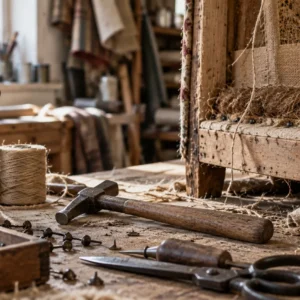
He was looking for an old chair.
Someone was giving it away on Facebook.
It wasn’t particularly rare.
It wasn’t especially valuable.
In fact, he thought it was worth about fifty pounds.
The plan was simple.
Collect it.
Restore it.
Sell it.
Instead, he met the woman who owned it.
She was eighty-three years old.
She told him she had lived with that chair for more than fifty years.
Something changed.
Scott stopped seeing an old chair.
He started seeing fifty years of someone’s life.
By the time he left, he no longer wanted to restore it so that someone else could own it.
He wanted to restore it so that she could keep it.
That small moment says something remarkable about furniture.
And almost nothing about upholstery.
More Than Somewhere to Sit
The chair wasn’t valuable because it was old.
Nor because it was rare.
Its value came from somewhere else.
It had quietly lived alongside one family for more than half a century.
It had been there for birthdays.
Christmases.
Ordinary Tuesday evenings.
The first cup of tea.
The last conversation before bed.
Years so ordinary that nobody thought to remember them.
Until one day they realised the chair had been there for all of them.
To anyone else, it was simply an old chair.
To its owner, it had become part of the home itself.
Furniture has a quiet way of doing that.
It asks for almost nothing.
It simply stays.
Fifty Years Cannot Be Replaced
When Scott heard she had owned the chair for more than fifty years, he stopped thinking like an upholsterer.
He started thinking like a custodian.
Until that moment, he had seen an old piece of furniture.
Now he saw something very different.
He saw half a century of ordinary life.
He offered to restore the chair without charging her.
Not because it made financial sense.
Because some things simply feel too important to measure in money.
He hoped she could continue living with the chair she already loved.
In the end, neither she nor her daughter wanted it back.
But that almost isn’t the point.
The offer tells us everything we need to know.
Scott wasn’t trying to save an old chair.
He was trying to protect fifty years of someone’s life.
Sometimes the greatest act of craftsmanship isn’t making something new.
It is recognising when something already carries a history worth preserving.
Furniture Collects Lives
We often think furniture wears out.
Perhaps the opposite is true.
Perhaps furniture fills up.
Every scratch tells a story.
Every faded arm remembers a familiar hand.
Every softened cushion marks another evening spent in the same place.
Every careful repair says one simple thing.
It was worth keeping.
Over the years, children grow taller.
Families become smaller.
Rooms are redecorated.
Walls are painted.
Homes are bought and sold.
Life keeps moving.
The chair quietly stays where it has always been.
Until one day, people realise they are no longer looking at a piece of furniture.
They are looking at part of their own history.
Strip away every mark.
Replace every worn edge.
Erase every sign of use.
And something else disappears too.
Not quality.
Memory.
Why Restoration Is Different
Buying something new begins a story.
Restoring something old allows the story to continue.
That is why restoration feels different from replacement.
One looks forward.
The other looks back.
Neither is wrong.
But they are not the same.
Only one carries fifty years of ordinary family life within its frame.
No craftsman can build that.
No workshop can manufacture it.
Time is the only maker capable of that kind of work.
The role of the craftsman is much more humble.
To care for what time has already created.
To preserve it.
To strengthen it.
And then quietly return it to the life it already belonged to.
Editorial Conclusion
Perhaps that is why we become attached to furniture.
Not because it is expensive.
Not because it is fashionable.
But because it quietly witnesses our lives without ever asking to be noticed.
Scott thought he was collecting an old chair.
Instead, he found fifty years of someone’s life.
He offered to repair the furniture.
What he was really trying to preserve was something far less tangible.
A relationship between a person and the object that had shared her home for more than half a century.
An eighty-three-year-old woman thought she was giving a chair away.
Scott thought he was collecting one.
But perhaps neither of those things was really true.
The chair wasn’t simply being given away.
It had become inseparable from the life that had been lived around it.
Fifty years of ordinary mornings.
Conversations.
Christmases.
Quiet evenings.
The familiar comfort of always knowing where your chair was.
It had quietly become part of the home itself.
Perhaps that is what good furniture eventually becomes.
Not something we own.
Something that quietly helps to tell the story of who we are.