The marks left by everyday living reveal why lasting craftsmanship matters far more than perfect furniture ever could.
Nobody is surprised when a mechanical watch goes in for a service.
Or a classic car.
Or a grand piano.
These are things we expect to look after. We understand that years of careful use deserve years of careful maintenance.
A sofa rarely appears on that list.
Which is why one recent conversation in our workshop stayed with us.
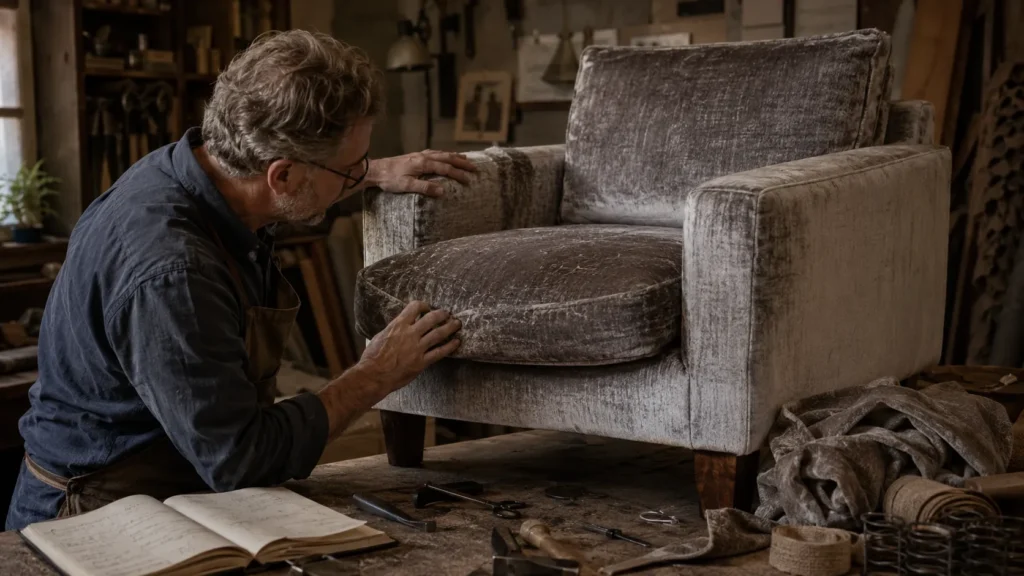
A customer contacted us about five John Sankey sofas we had made more than ten years ago. They weren’t looking for replacements. They wanted to know whether the originals could be stripped back, inspected, rebuilt where necessary and upholstered again before returning to the same home.
It wasn’t a question about buying another sofa.
It was a question about keeping these ones.
Nobody decides, on the day a sofa is delivered, that one day it will be restored.
That decision arrives quietly.
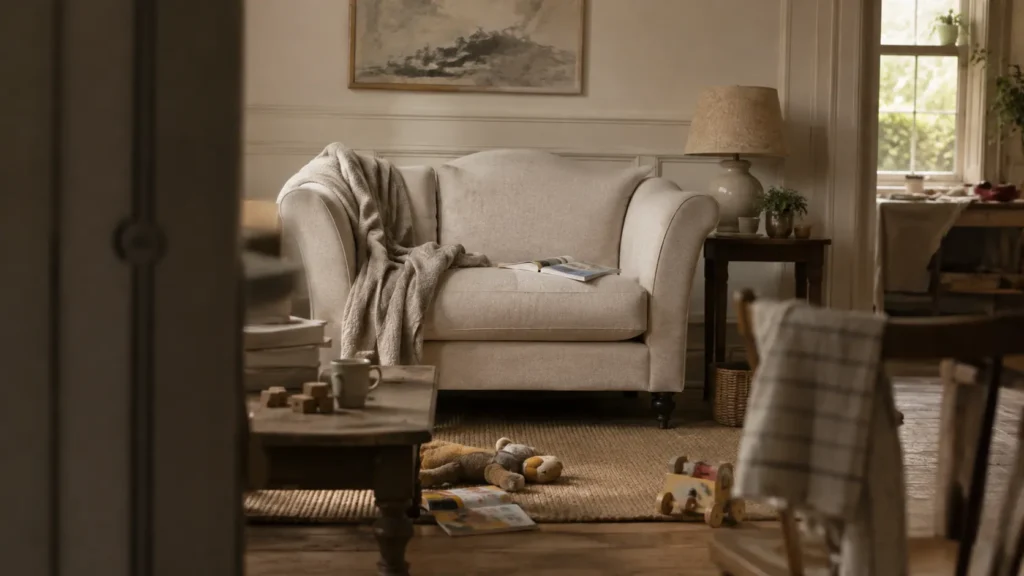
It happens somewhere between ordinary evenings, Sunday afternoons, unexpected visitors and the familiar routine of sitting in exactly the same place at the end of another day. Gradually, almost without noticing, the furniture stops feeling temporary. It becomes part of the life unfolding around it.
Perhaps that is the moment something changes.
People rarely service the things they merely own. They service the things they hope to keep.
When an older sofa returns to the workshop, experienced upholsterers rarely begin by looking for faults.They begin by looking for clues.
One arm is softer than the other. One seat has settled a little lower through years of being chosen first.
The fabric has become smoother where the same hand rested every evening. A cushion carries the shape of thousands of ordinary moments that nobody imagined would one day matter.
None of those details means very much on its own. Together, they tell you that somebody lived here.
An upholsterer cannot tell you the family’s names. They cannot know what conversations took place, who always chose the corner seat or why one place became everyone’s favourite.
But they can see the quiet evidence that those things happened.
The marks are not random. They are patterns.
Years of people returning to the same places, without ever deciding that they would.
We often think of wear as the moment something begins to lose its value. Yet many of the things we treasure most tell exactly the opposite story.
The polished edge of an old staircase. The leather strap of a favourite watch. The steering wheel of a car kept for decades.
They are not meaningful despite being used. They are meaningful because they have been used so consistently that ordinary life has left its mark upon them.
Perhaps the same is true of a sofas.
What looks like wear may simply be evidence that life happened here, again and again, until nobody noticed it happening anymore.
That is where craftsmanship quietly enters the story.
Not to demand admiration. Simply to make all of this possible.
We often describe craftsmanship in terms of timber, springs, stitching and construction. Those things matter, but they are only the beginning. Their real purpose is far simpler.
To remain.
A sofa cannot become familiar if it disappears too soon. It cannot become part of family life if it is designed only for the day it arrives.
Craftsmanship matters because it gives ordinary life enough time to leave its mark.
Eventually, the sofa is no longer the one that was delivered. It becomes the one everyone knows. The place someone always settles first. The sofa quietly moved aside every December to make room for the Christmas tree before being returned to exactly the same place a few days later.
The one children once climbed across and adults now fall asleep on after Sunday lunch.
Not because anyone planned it. Simply because life kept returning to it.
That is why restoring a sofa is different from replacing one.
The decision has very little to do with fashion. Very little to do with furniture. It is the quiet recognition that something has become woven into the ordinary rhythm of home.
The owner is not searching for another sofa that looks the same. They are hoping to continue living with the one that already knows their family.
Perhaps that is the greatest compliment a piece of furniture can receive.
Not that it lasted for ten years. But that, after ten years of ordinary life, somebody looked at it and decided it was worth beginning again.