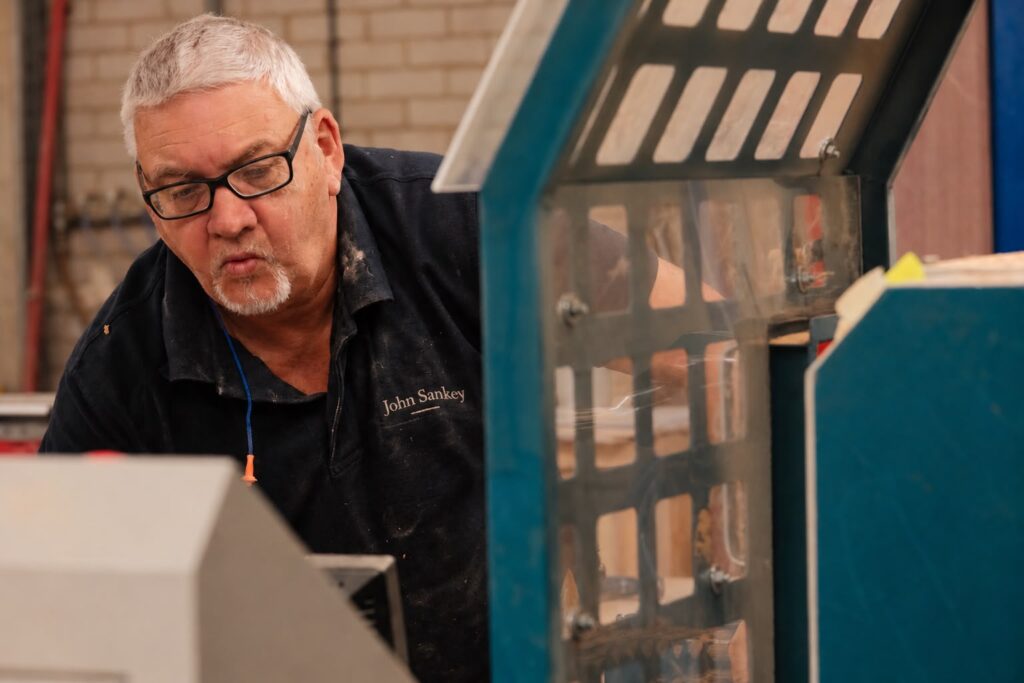
Every workplace has somebody who hears a machine change before anyone else does. The difference may be no more than a slight flattening of its note, there for a second before it disappears beneath everything around it. Other people carry on talking. The experienced person stops, waits for the sound to come round again and looks towards the machine. By the time anyone asks what is wrong, they are already walking towards it.
The same person often knows which drawer holds the awkward tool that has no proper name. They notice that a stack of materials has been left in the wrong order, or that a job which looks finished will need looking at once more before it leaves. Nobody has written any of this down, and most of the workshop only becomes aware of it when the person who noticed begins to move.
Walk through Long Eaton and the evidence of repeated work appears at the scale of streets. Long upper floors run behind rows of windows, loading entrances interrupt brick walls and yards open where materials once had to be moved between buildings. Some names have disappeared from above the doors. Some doors now admit different materials and different people. The shape of the work remains visible in the shape of the town.
Before upholstery became central to Long Eaton, the town was organised around textiles and lace. By the nineteenth century, large mills and smaller workshops had drawn machinery, materials and specialist labour into the same compact district. Lace placed its demands upon the buildings: room for machines, light across long working floors and routes through which material could arrive and leave. Outside, the working day could be heard in gates opening, machinery starting and trolley wheels crossing factory yards.
The change that followed took years. Lace weakened while furniture businesses were already working nearby, and for a time the two industries occupied the town together. The trades used different materials and required different skills, so much of the new work had to be learned afresh. What upholstery found was an industrial landscape already full of workshops, suppliers, working families and buildings made to receive difficult work. Long Eaton did not demolish one industry and build another. Upholstery moved into the rooms lace had left behind.
Inside those rooms, the changes would have been immediate and practical. Frames replaced lace machinery, rolls of fabric arrived at entrances built for other materials, and benches gathered where different work had once been repeated. Beyond the door, the same compact streets still allowed specialist businesses to remain close enough to depend upon one another.
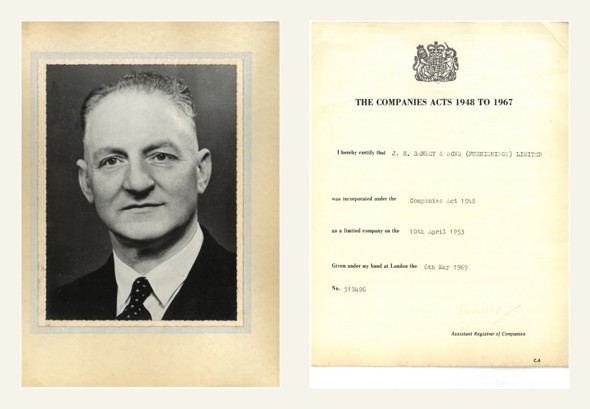
John H Sankey entered Long Eaton during that overlap. The certificate of incorporation records J H Sankey and Sons Furnishings Limited on 10 April 1953, when lace had not entirely disappeared and the town's furniture trade was already established. It gives the company a precise beginning within a much older manufacturing place. The date belongs to John Sankey; the town around it had already spent generations making.
A portrait and an incorporation certificate are easy things to preserve because they can be placed in a folder, given a date and returned to when a question needs answering. The less orderly evidence surrounded the new company every day: occupied workshops, neighbouring trades and people accustomed to work that only looked simple after it had been completed well. The certificate records when the company began, while the town explains something about where it began.
The furniture made in 1953 would be immediately recognisable as belonging to another period. Materials have changed, machinery has changed and the factory has been rearranged around work that could not have been anticipated then. Yet certain objects remain for uncomplicated reasons. A pattern is kept because it will be needed again, a tool stays near the person who uses it, and new pencil marks appear beside older ones.
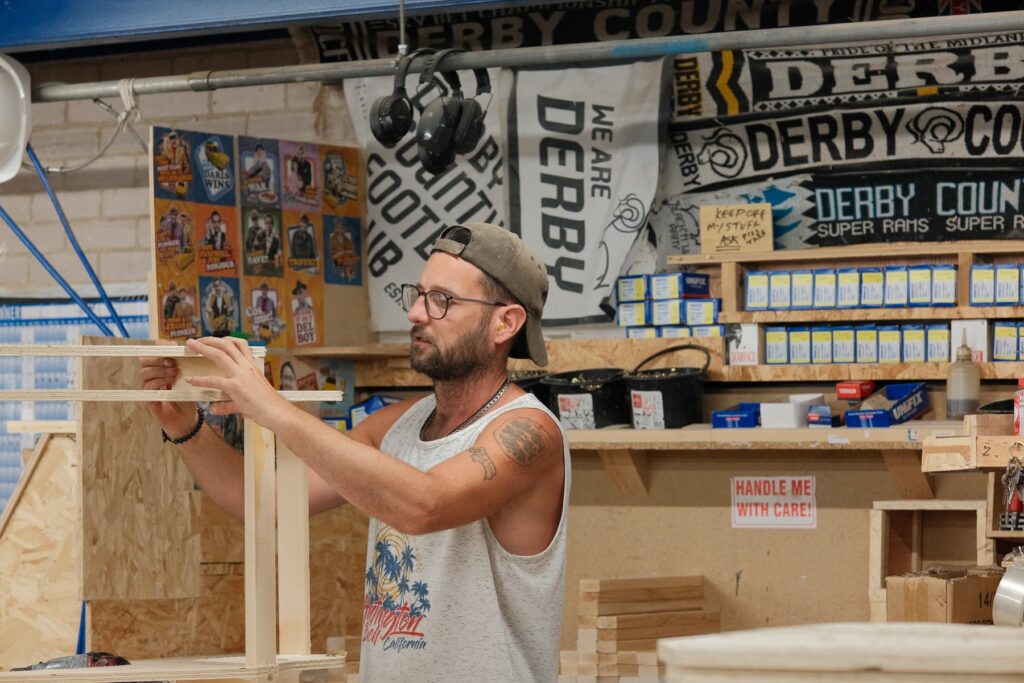
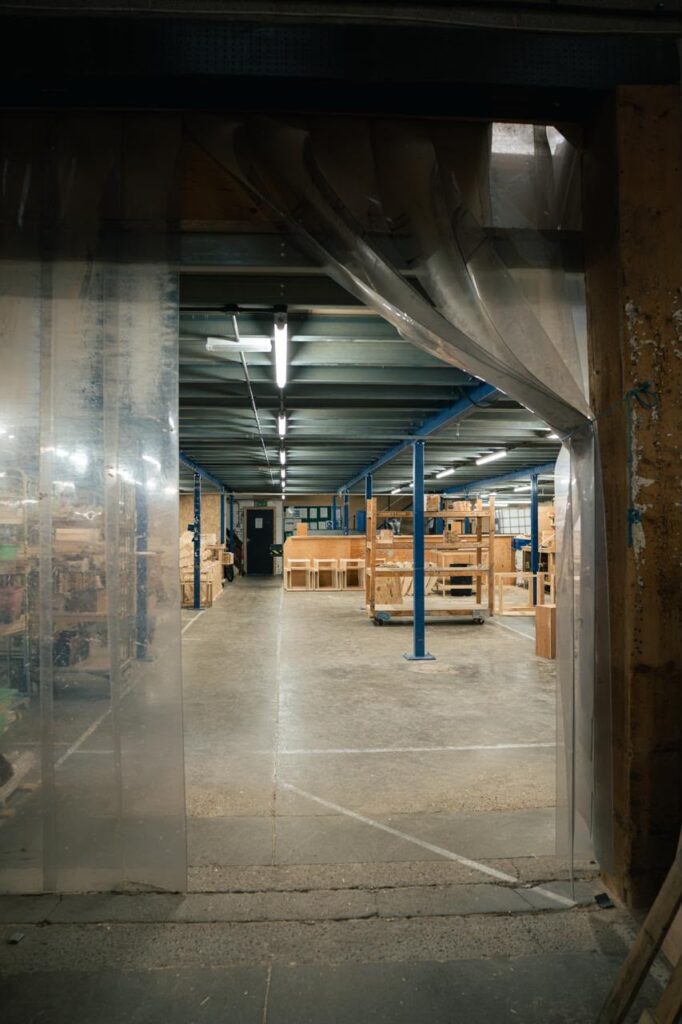
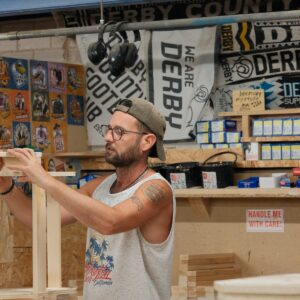
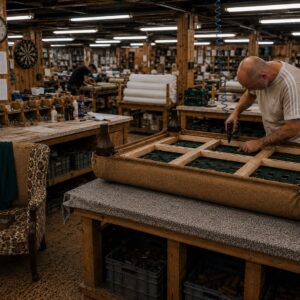
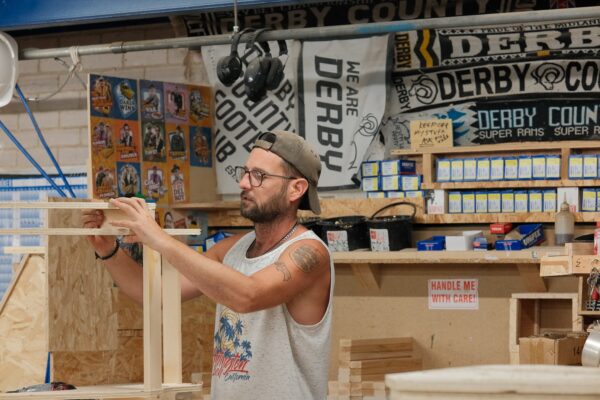
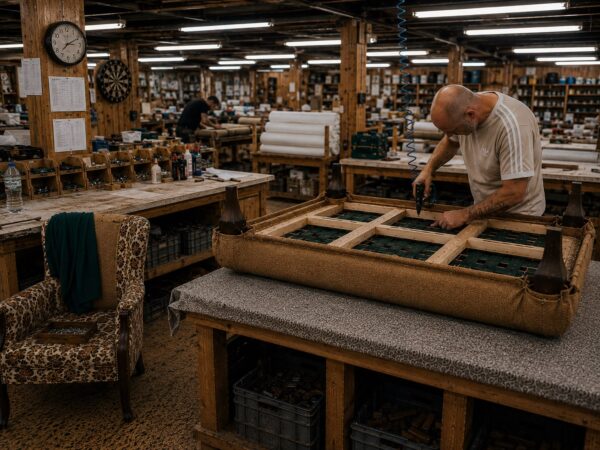
Inside the John Sankey factory, none of this waits to be demonstrated. A frame stands at one station while another moves forward. Fabric is unrolled across a surface, checked, folded and returned to its place. Tools remain within reach, offcuts collect temporarily and a trolley occupies the route somebody will soon need to use. The room keeps changing in small ways as each job passes through it. Something is always waiting for the next pair of hands.
Patterns and templates carry softened edges where they have been lifted from storage many times. Handwritten signs settle into the background until a visitor notices the language of the workshop written directly onto its walls and shelves. Workbenches show cuts, stains and measurements that were useful for a moment and never completely disappeared. Each mark is minor, but together they reveal how often the room has been asked to make something.
The people working among these objects concentrate on what is in front of them. They look along an edge, press a material, step back from a frame or return to a fastening that another person might have accepted. The movement is usually brief. Work resumes without anyone stopping to explain what was seen. By the time the piece moves on, the decision has vanished inside it.
Experience changes the threshold at which something becomes noticeable. A small variation in sound, alignment or resistance becomes enough to make someone look again, even when the finished work would have concealed the difference. Years of repetition do not make every decision conscious. They allow attention to arrive sooner.
A town reveals its experience in a similarly unannounced way. It can be found in the buildings that receive another use, in the businesses that continue to gather near one another and in the work that still seems natural to undertake there. Long Eaton changed because it had to, and the evidence of that change remains part of an ordinary journey through its streets.
The present factory holds several periods of that story at once. Frames and materials belong to current orders, patterns wait for future work and the building has already accommodated more working days than anybody inside it could count. Nothing needs to be arranged as an exhibition. A frame waiting beneath the strip lights is today's work, in a room that has been useful for much longer.
Sooner or later, the person who heard the changed note returns to the machine. The interruption may have been brief enough for most of the workshop to miss, and the finished furniture will contain no record of it. The person listens once more, then steps away. The machine starts again, sounding as it should, and the room carries on.