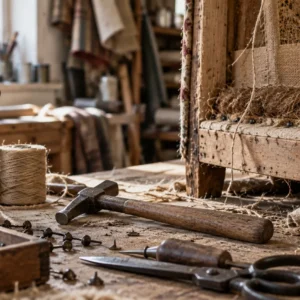
Scott Bell started upholstering furniture at John Sankey 26 years ago. Since then, he has learned almost everything you might reasonably expect an upholsterer to know. He has also discovered that artificial grass is surprisingly good at hiding staples.
That particular lesson came from a sofa Scott was asked to make for an exhibition. Somebody had decided that it should be upholstered in artificial grass, which presented Scott with the unusual problem of persuading something normally laid across a garden to behave like fabric.
It wasn’t particularly cooperative, but it did have one excellent quality: you could fire a staple straight through it and the staple simply disappeared.
Working somewhere for a long time leaves you with two kinds of knowledge.
Scott remembers this 26 years into a career in upholstery because working somewhere for a long time leaves you with two kinds of knowledge. There is the knowledge you are supposed to acquire: how different fabrics behave, how much tension something needs and the tiny adjustments that separate work that is nearly right from work that is right. Then, quietly accumulating alongside it, is another body of expertise that nobody knew you were going to need.
This second education is rather less transferable. It contains the strange jobs, the awkward materials and the things that went wrong once and were therefore never allowed to go wrong again. It contains solutions that would sound ridiculous to anybody who wasn’t there when the problem occurred. And, in Scott’s case, it contains the useful information that should artificial grass ever return to the upholstery department, at least hiding the staples won’t be a problem.
Every workplace probably has knowledge like this.
Spend enough years doing something and all sorts of things become completely ordinary to the people who know them and almost invisible to everyone else. Most of it would never appear on a CV, but it becomes part of knowing a place and knowing a job.
There are sounds that become part of working somewhere for a long time too. Scott has spent 26 years surrounded by the noises of upholstery, so when he was asked what sound he most associated with the job, he could have offered something rather lovely about craftsmanship.
He didn’t.
“Tacking guns,” he said.
Then he thought about it a little longer.
“And bad music.”
The tacking guns are understandable.
They fire repeatedly across the workshop until eventually a noise that would make a visitor look around barely registers with the people working beside it. The music is apparently just as persistent, although 26 years have yet to produce a satisfactory solution.
Eventually you get past what they do and reach the things nobody thought to ask about.
Perhaps that’s one of the pleasures of asking somebody about work they have done for most of their life. Eventually you get past what they do and reach the things nobody thought to ask about. Not the things somebody decided were important enough to put on a CV, but the peculiar little pieces of knowledge that could only have come from being there.
Scott has upholstered a great many sofas since the artificial-grass one. But somewhere among everything more than a quarter of a century in upholstery has taught him, one wonderfully unnecessary piece of expertise remains.
Artificial grass hides staples beautifully.
The music, apparently, remains beyond help.