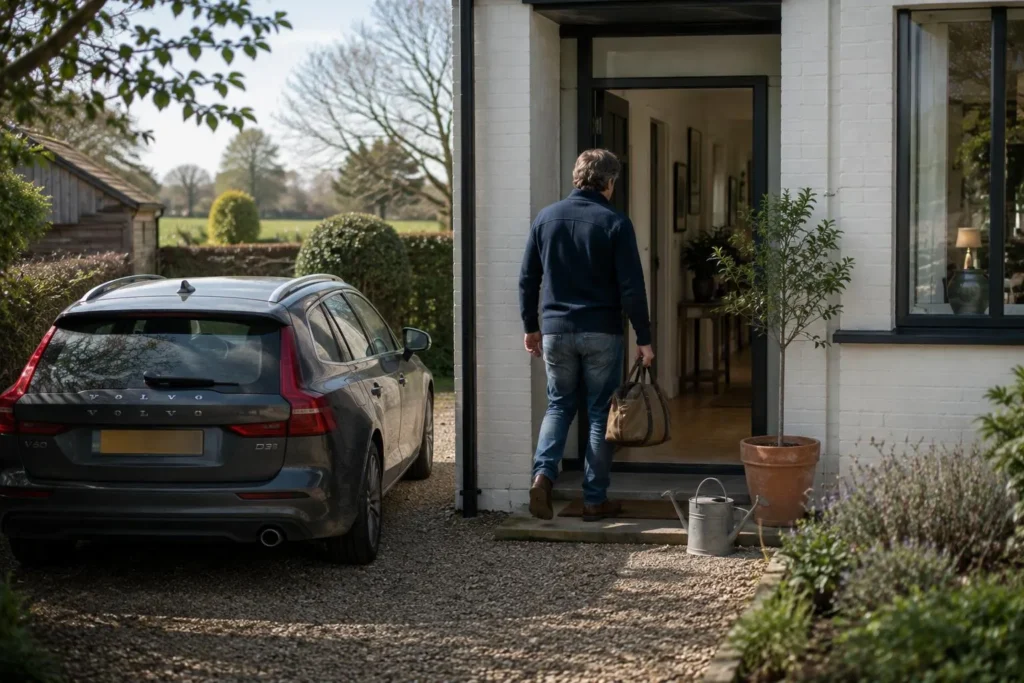
He looked at around fifty houses before he bought one. Not fifty listings glanced at online, or fifty photographs saved for later, but roughly fifty homes considered seriously enough to go and see. By the time he reached the house he eventually bought, he had spent months comparing streets, rooms, driveways and all the other things that seem enormously important while you are choosing somewhere to live.
Earlier in this issue, we wondered how much information is enough before we finally allow ourselves to choose. Some people seem able to recognise the answer quickly. Others need to compare, research and understand before confidence arrives. He belongs firmly in the second group.
He began with a fairly exact list. The house needed to be detached, parking mattered, the age and style mattered, and he did not want a project that would consume years of work. Some of those requirements had been earned through experience. Having lived somewhere where parking was a constant nuisance, he already knew that a detail which looks fairly minor during a viewing can become remarkably large when you have to live with it every day.
He researched more than the houses. He walked around the areas, went for something to eat nearby and tried to understand what an ordinary Tuesday might feel like there, rather than simply how the place felt during a viewing. After a while, he could see how much could change within a couple of streets.
The houses were teaching him too. After enough viewings, he began developing his own sense of value. An expensive extension did not automatically make a house worth more to him, just as a beautifully presented room did not necessarily make the underlying house any better. Things that might have impressed him at the beginning gradually became easier to see past.
By house thirty or forty, he was no longer looking with the same eyes he had used at house one.
He had seen enough versions of similar things to know which differences mattered. Comparison had stopped simply producing more choices and had started removing them.
One of his original requirements was enough driveway space for a seven-metre campervan. It mattered enough to make the list, until he began seeing what keeping it on the list meant giving up elsewhere. Eventually, the campervan requirement went.
That small change says quite a lot about what happens when an imagined decision meets a real one. Before we begin looking, everything can be essential because none of the requirements has yet had to compete with another. It is only when the perfect driveway belongs to the wrong house, or the right house comes with the wrong driveway, that we discover which things really deserve to remain on the list.
The house he eventually chose was detached. It had the parking he needed, was the right sort of age and style, and represented the value he had gradually learned to recognise. It did not satisfy every condition he had taken into the search.
By then, that no longer mattered in quite the same way.
After fifty houses, he was not waiting for one that won every comparison. He was able to recognise the one that was right. As he described it, when he finally landed on the house, he was quite confident that he knew.
There is a useful difference between right and perfect.
Perfect keeps every original requirement alive and asks the eventual choice to satisfy them all. Right allows some of them to become less important because the process itself has taught us something.
Even after buying it, he continued watching a few of the other houses he had considered. He wanted to see what happened to their prices and whether the market would confirm some of the judgements he had made. The house had been chosen, but the habit of comparing had not disappeared overnight.
That feels rather more recognisable than the idea that a good decision ends with absolute certainty. We can choose something, be happy with it and still glance occasionally at the thing we did not choose. Sometimes confidence arrives before curiosity leaves.
Time has now provided a much better test than another viewing ever could. Asked how right the decision feels today, he puts it at roughly 90 per cent. Not perfect, even now. Just very right.
And if he had to buy another house?
He would still research. He would still compare. He would still be exacting about the things that mattered to him. What he probably would not do is spend quite so much time on houses he now knows are wrong.
He does not regret seeing the fifty. He thinks he needed to do it in order to make the decision he eventually made. The interesting thing is that he may never need to do it in quite the same way again.
The fifty houses were not wasted. They were how he learned what mattered.
The search produced more than a house. It gave him a better filter for the next decision.
You can see traces of the same judgement elsewhere. He once spent time researching a watch because he wanted craftsmanship and quality without paying simply for a name. Years later, he still wears it to weddings and occasions. Its value to him has survived long after the comparisons that led him to it have been forgotten.
A bicycle taught him something slightly different. At one point he bought the best specification he could, only to discover that beyond a certain point the extra specification did not really improve the thing he cared about. He wanted to ride the bike. Some of the things he had paid more to acquire mattered considerably more while choosing than they did once he was actually using it.
Perhaps that is why experience can make somebody quicker without making them less careful.
It does not necessarily teach us to research less. It teaches us what no longer deserves researching.
The first time around, we may need to compare ten versions of something before understanding the difference that matters. Years later, we can sometimes dismiss nine of them almost immediately. The decision appears quicker from the outside, but much of the work was done a long time ago.
That is what the fifty houses left behind.
He still lives in the one he chose. The lists have gone, the viewings have stopped, and nobody is asking whether the driveway should have been longer. The decision that once occupied months of his life has become the place where ordinary life happens.
If he had to choose again, he would still look carefully. He would still compare. He would still want to understand what he was getting and why it was right.
He just might not need another fifty houses to know when he had seen enough.