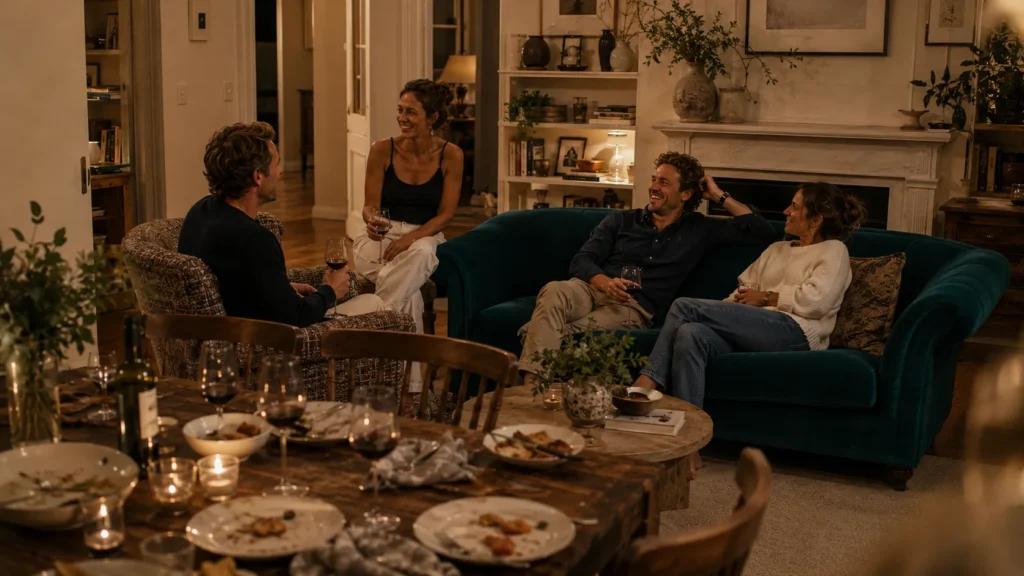
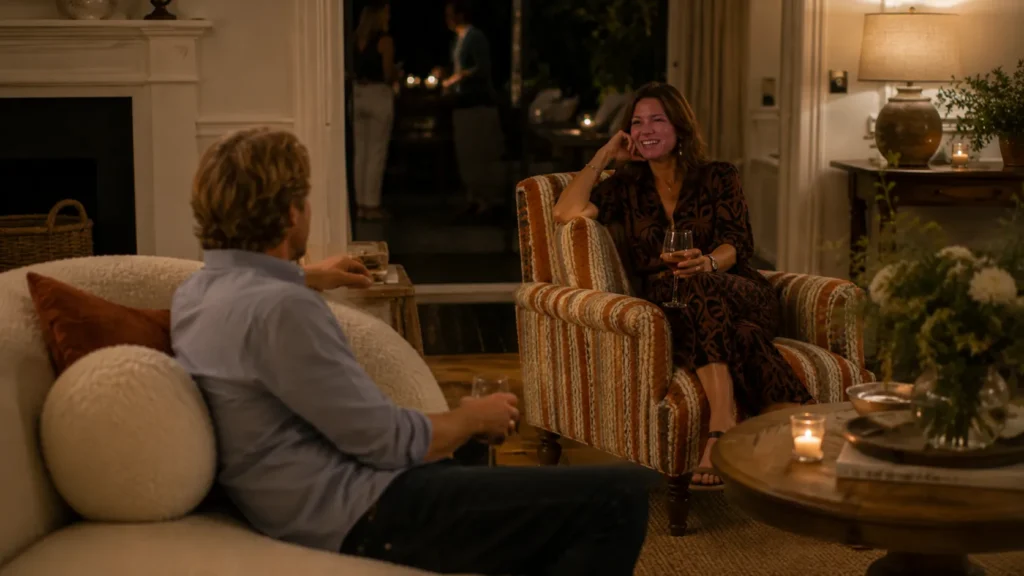
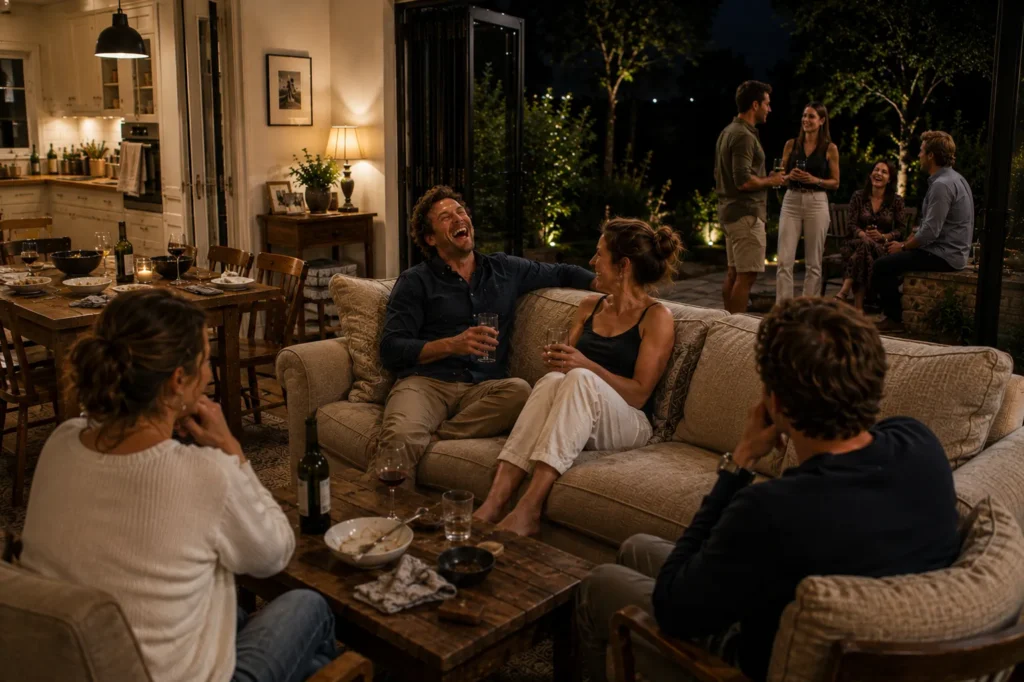
Someone says, “We really should go.” Everyone agrees. Nobody moves.
It is usually quite late by then. Dinner finished some time ago, the plates have been pushed far enough away to stop being relevant, and whatever sensible departure time was mentioned earlier in the evening has quietly passed. Somebody starts another story instead. The person who was definitely leaving ten minutes ago sits back down.
There is a particular kind of evening that seems to become better at precisely the point when it should be ending.
It does not necessarily happen on important occasions. In fact, important occasions can be rather bad at producing it, perhaps because everyone is trying so hard to have a good time. The really good evenings often arrive with much less ceremony.
They may have started with a plan. Dinner at seven. A couple of friends coming round. Nothing too late because somebody has an early start, a child to collect in the morning, a drive home, or simply the vague adult conviction that eleven o’clock is a perfectly respectable time to call it a night.
At the beginning, everyone behaves accordingly. Coats are taken, drinks are offered, people ask where they should sit. The person whose house it is remains faintly on duty, noticing empty glasses and wondering whether the food needs another five minutes. Conversation behaves itself too, at least for a while.
Then, if it is going to be one of those evenings, something changes.
Nobody decides that it should.
The first sign may be very small. Someone who asked where the glasses were two hours ago gets up and fetches one for themselves. Somebody moves from the chair they were originally given. The person who has been hosting all evening finally stops hosting, because by now nobody particularly needs looking after.
Conversation has changed too. It no longer appears to have a destination. A story about work has somehow become a story about a disastrous holiday fifteen years ago, which reminds somebody else of something that happened at a wedding, and before long nobody can remember what they were originally talking about.
This does not seem to trouble anyone.
The same stories sometimes come back. Every group of people who have known one another long enough appears to possess a few of these. Someone begins one and everybody else knows exactly what is coming, including the person who will interrupt halfway through to insist that this is not quite how it happened.
They tell it anyway.
Perhaps that is one of the peculiar pleasures of easy companionship. A story does not always have to be new to be worth hearing. Sometimes the fact that everyone knows it is part of the enjoyment. The laughter arrives before the ending because the ending isn’t really what everybody is waiting for.
By now, the evening bears remarkably little resemblance to the one that was planned.
Dinner may have brought everybody together, but dinner is no longer the point. The host is no longer quite the host. The guests are no longer behaving particularly like guests. The evening has slipped out of the hands of the people who organised it and seems perfectly capable of continuing without them.
Perhaps some of the best evenings begin when the plan runs out.
We spend quite a lot of our lives organising things. We arrange dates, make reservations, send messages, check diaries and decide who is bringing what. Even relaxation can acquire an alarming amount of administration.
Then, occasionally, all of that work does its job and quietly disappears.
What remains is much simpler.
People.
Not people being interesting, necessarily. Not everyone sparkling with conversation or producing stories worthy of retelling elsewhere. Often there is quite a lot of nonsense. People interrupt one another. Someone tells the story badly. Somebody laughs so hard that they temporarily lose the ability to contribute anything useful at all.
That may be when companionship is at its most recognisable. Nobody is trying particularly hard anymore. The evening has become comfortable enough to survive imperfect stories, long digressions, repeated jokes and the occasional conversation in which three people are speaking simultaneously and somehow everyone appears to understand it.
There is a moment, eventually, when somebody notices how late it has become.
The discovery is greeted with disbelief. Someone looks at a phone and assumes, briefly, that the time cannot possibly be right.
This produces the evening’s second official departure announcement.
Everyone agrees again.
Nobody moves again.
Eventually, of course, they do.
The room is left behind. There are glasses in places they did not begin the evening, chairs at slightly odd angles and the evidence of a meal nobody thought important enough to clear away while the conversation was still good.
Tomorrow, it will all be put back.
At the time, nothing particularly significant appears to have happened.
That may be the strangest thing about evenings like these.
You don’t notice a memory becoming a memory.
Nobody sitting in the room thinks that this particular stretch of an otherwise ordinary Thursday or Saturday night will become part of the history of their friendship. Nobody knows which joke will be mentioned again in five years, which ridiculous story will somehow survive, or which completely incidental detail somebody will remember with extraordinary clarity.
We tend to recognise memories afterwards.
Somebody says, “Do you remember that night when…?” and an evening that seemed utterly ordinary while it was happening suddenly returns almost complete.
You remember who was there.
You remember where someone was sitting.
You remember the story.
You may even remember the laugh.
Not polite laughter, or the little acknowledgement we give when somebody says something mildly amusing. The other sort. The helpless, full-bodied kind that briefly makes adults behave like children again and causes somebody else to start laughing simply because you are.
None of those details was entered into a diary. Nobody preserved them deliberately. They attached themselves to the evening while everyone was busy doing something else.
We are naturally good at recognising the large occasions. Birthdays, weddings, Christmases, anniversaries, first days, last days and all the events we know in advance we are supposed to remember. We photograph them, prepare for them and understand their significance while they are happening.
But a surprising amount of what eventually matters arrives without an announcement.
An ordinary meal lasts longer than expected. Friends stay. Children who were supposed to be asleep wander back into the room. Someone puts music on. A conversation becomes funnier, stranger or more honest than anybody intended.
The evening stretches.
Nothing asks to be remembered.
And yet some of it is.
Over enough years, a home quietly accumulates these occasions.
Not just the important ones, but hundreds of evenings that never acquired names. Meals that ran late. People who dropped in and stayed. Conversations that began in one room and finished in another. Friends who eventually stopped asking where things were kept.
No single one of them changes a place.
No particular story alters a room. No burst of laughter leaves a mark that can be pointed to afterwards.
But something accumulates.
The people who return know where to sit. They know which cupboard contains the glasses. They know the stories and the slightly disputed versions of them. They have memories attached to rooms that belong to them even though the rooms do not.
You can finish a room. Furnish it, decorate it, light it beautifully and have everything exactly where it ought to be.
What takes longer is the history.
That arrives while dinner is going cold because nobody wants to interrupt the conversation. While somebody is laughing too much to finish what they were saying. In the extra half-hour after everyone agreed the evening was over.
Ordinary moments are particularly good at hiding their importance.
Perhaps that is fortunate.
An evening would become unbearable if everyone spent it consciously appreciating the creation of a future memory.
Better that nobody notices.
Better that they are simply living it.
Eventually, someone finds their coat.
This produces another round of goodbyes, which progresses successfully as far as the front door before somebody remembers one last thing they meant to say.