How Long Eaton carried its knowledge from lace into furniture—and how John Sankey began in the middle of that inheritance.
Every workplace seems to have one person who knows things nobody remembers teaching them.
They know which drawer has always held the awkward little tool everyone else spends ten minutes looking for. They notice when a machine sounds slightly different, although nobody else can hear the change. They remember why a particular job is always done in a certain order, even if that reason disappeared years ago with the person who first insisted upon it. Ask them how they know and the answer is often wonderfully unhelpful. “That’s just how we’ve always done it.”
It is tempting to imagine that this kind of knowledge belongs to one individual. Yet if they retire, much of it somehow survives. Someone else begins reaching for the same drawer without thinking. The same quiet checks are made before work begins. The same standards continue to shape decisions long after the people who first established them have gone.
Places remember through people.
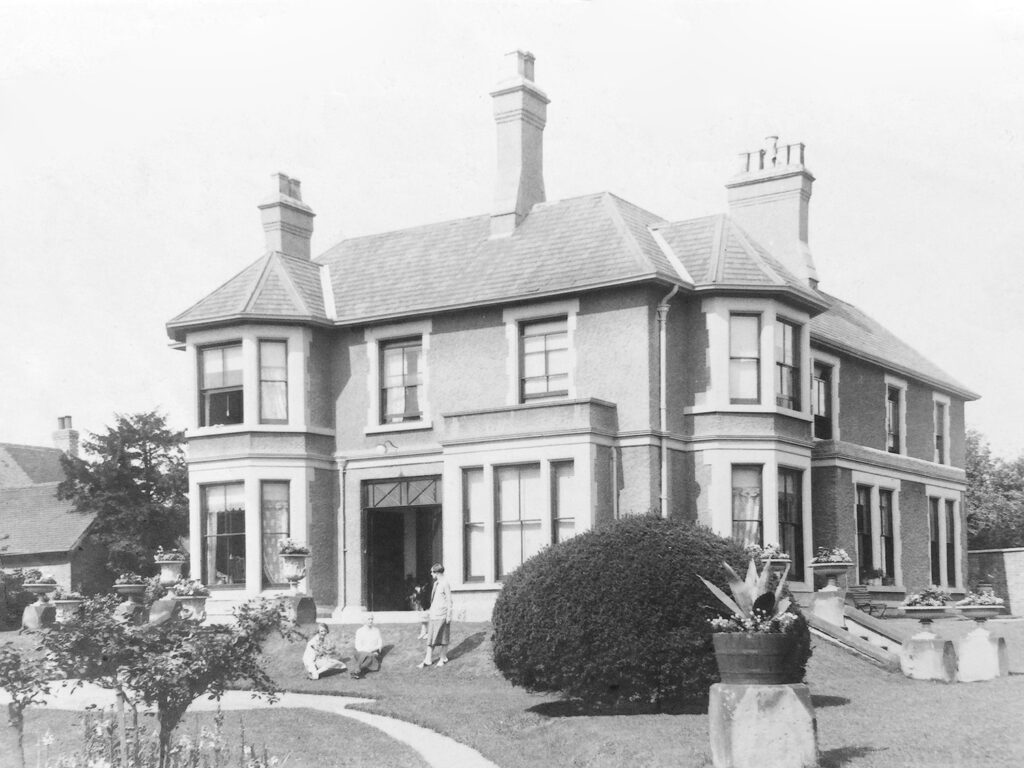
We often imagine that history survives inside buildings. We preserve old photographs, restore factory facades and keep important documents in carefully labelled archives because they appear to offer permanence. Yet buildings can stand empty, photographs can lose their names and documents can record only what somebody thought to write down. The things that matter most to a place often survive somewhere far less obvious.
They survive in judgement.
Long Eaton has always understood this, although perhaps not in those words. Long before it became known for upholstery, it was a town of lace. The mills that filled its streets demanded extraordinary patience and precision, producing fabrics whose complexity depended upon thousands of careful decisions disappearing inside the finished work. Those decisions were never simply the achievement of machinery. They belonged to people who learned, observed and quietly passed their judgement to the next pair of hands.
When fashions changed, the town changed with them.
From the outside it can look as though one industry ended and another began. Lace declined. Furniture grew. Mills found new purposes. Different names appeared above familiar doorways. History often tells the story that way because it is easier to follow products than people.
The people, however, were never starting again.
Many remained in the same streets, walked through the same factory gates and carried with them the habits that difficult work had taught them. They already understood that careful making depends upon patience more than speed, observation more than instruction and judgement more than process. The products changed. The character of the work did not.
That may be the real inheritance of a town.
Industries do not survive because factories survive. They survive because judgement finds another pair of hands.
Once you begin looking for that inheritance, you notice it everywhere. It is there in the building that still stands after its original purpose has disappeared. It is there in the family whose work changes over generations without losing its pride. It is there whenever experience quietly adapts instead of insisting that yesterday must be repeated exactly.
That is where John Sankey enters the story.
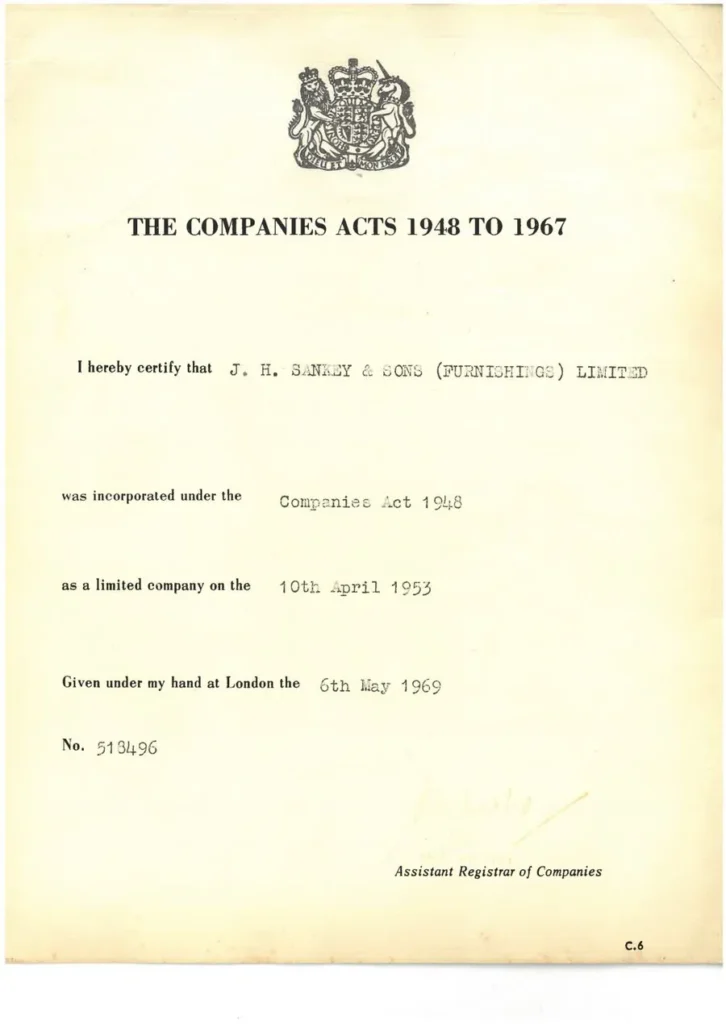
When John H. Sankey established the company in 1953, he was not creating furniture in a town that had never made anything before. He was joining a community that already understood the disciplines upon which fine furniture depends. Long Eaton had spent generations learning precision, repetition and care. Upholstery did not replace those qualities. It inherited them.
There is a stained-glass window overlooking the John Sankey showroom. At first glance it appears to celebrate the town’s past, depicting the mills that shaped Long Eaton’s identity. Spend a little longer with it and the window begins to suggest something gentler. Every morning the light passes through those images before falling across a workshop where people are still making with the same patience the town has valued for generations. The work has changed. The habit of making has not.
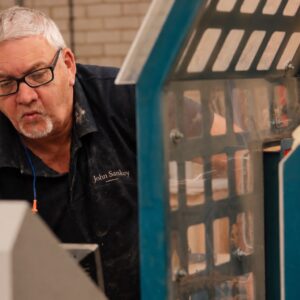
Walk through the workshop today and another kind of history becomes visible. It does not sit behind ropes or inside display cabinets. It hangs on walls, slides from drawers and carries the marks of repeated use. Patterns worn smooth by decades of handling. Handwritten names that outlived the collections they first described. Small pencil notes made because somebody discovered a better way and quietly altered the pattern for everyone who followed.
What makes these objects remarkable is not their age.
It is that they are still working.
An archive usually preserves the past by protecting it from use. A workshop preserves the past by trusting it with tomorrow’s work. A pattern matters because somebody reaches for it again. A drawer matters because everyone still knows where to find it. Memory survives because it continues to earn its place.
Perhaps that explains why experienced craftspeople often struggle to describe what they know. Ask how they recognised that a seam was not quite right or why they chose to undo work that appeared perfectly acceptable, and the answer is rarely technical. “You just know.” “You get a feel for it.” “After a while you notice.”
Those answers are not evasions. They are evidence that some knowledge has travelled beyond language. Years of repetition have turned instruction into instinct. The judgement has moved from the page into the hands.
That movement is how institutions survive.
Manuals describe procedures. Drawings record dimensions. Neither can fully explain the moment an experienced maker pauses because something, almost imperceptibly, does not feel right. That decision is learned beside another person. It is observed before it is understood. Eventually it becomes part of someone else’s judgement, and the place quietly remembers again.
Homes accumulate life in much the same way. No room becomes meaningful all at once. Familiar routines leave small traces until belonging feels as though it has always been there. Workshops follow the same rhythm. Every repaired jig, every altered pattern and every habit passed from one colleague to another becomes part of a memory that no single person entirely owns.
Places remember through people.
Perhaps that is what the stained-glass window has really been watching all along. Not simply the passing of one industry into another, but the continuation of something much less visible. The mills taught a town how to make. The workshops carried that knowledge forward. Different products emerged. Different companies began. Yet the most valuable inheritance was never lace or furniture.
It was the quiet decision, repeated by one generation after another, that difficult work deserved to be done well.
We sometimes imagine that history survives in buildings. It rarely does. Buildings can stand empty, drawings can be filed away and machines can eventually fall silent. What lasts longest is something much harder to catalogue. Somebody remembers. They show somebody else. And for another generation, the place continues to know what it has always known.