There are rules to making furniture properly. The interesting part is knowing which ones matter.
Put the same chair in front of two experienced upholsterers. Give them the same frame, the same fabric and the same specification, and you might reasonably expect the finished chairs to be identical. Look closely enough, though, and each will carry small decisions made by the person who built it.
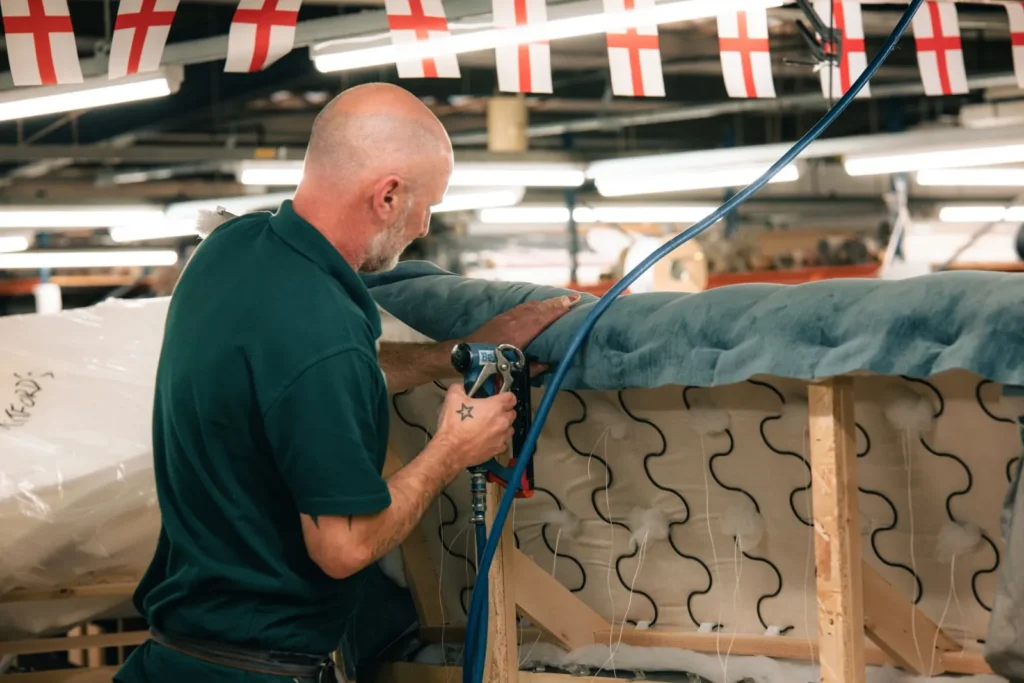
Scott has seen this many times. One upholsterer may pull the fabric a little differently, another may form a pleat differently, and even the position of an outside back can carry the judgement of the person who fitted it. The standard hasn’t changed and neither has the chair; what changes is the accumulation of small decisions between the specification and the finished piece.
This is easy to misunderstand when we talk about traditional craftsmanship, because from the outside tradition can look rather like repetition. There is a process, somebody learns it, and eventually they become very good at it. But becoming good at repeating something and understanding it deeply are not necessarily the same thing.
There is certainly plenty to learn. Before the fabric ever becomes the thing we notice, someone has thought about springs and clips, foam types and densities, thicknesses, preparation and how those different materials will eventually behave together. Get the preparation of an arm wrong and putting the fabric on beautifully won’t rescue it, because the mistake has already happened underneath.
Much of this work will eventually disappear. Nobody takes delivery of a finished chair and turns immediately to admire the spring clips, and very few people will ever see the preparation beneath an upholstered arm. Some of the decisions that matter most in making something well are hidden by the very act of finishing it.
Perhaps that is why experience can be surprisingly difficult to spot.
Give Scott a plain fabric and there is an established order in which he can work. He knows where to begin, what follows and how the different parts will eventually come together. Years of doing it mean that much of this no longer needs to be consciously worked out each time.
Give him a patterned fabric and watch what happens. If the pattern needs to meet properly across different parts of the chair, Scott may change the order of the work completely, starting with the main frame and working backwards so the smaller pieces fall where they need to. To somebody watching casually, the most interesting decision of the day might look like nothing more than starting in the wrong place.
It isn’t the process that has become less important. Scott understands it well enough to know what it is trying to achieve, so when following the usual sequence would make the result worse, he changes the sequence rather than the standard. Sometimes the clearest sign that somebody really understands a process is that they know when not to follow it in the usual order.
You may recognise that in people who are very good at other things. An experienced cook stops measuring something years before they stop caring how much goes in. Someone who has repaired the same kind of machine for decades may listen to it before reaching for a tool. The instructions haven’t become irrelevant; they have been absorbed deeply enough for judgement to begin.
[sankey_join_card]
That judgement does not mean anything goes. If something is wrong with a frame, hiding it beneath upholstery isn’t interpretation. Scott talks about stopping and correcting things even when doing so adds time, and about checking the details that will disappear into the finished piece. The makers check one another’s work too, because knowing where there is freedom also means knowing exactly where there isn’t.
Occasionally, the consequences of all those small decisions turn up somewhere far away from the person who made them.
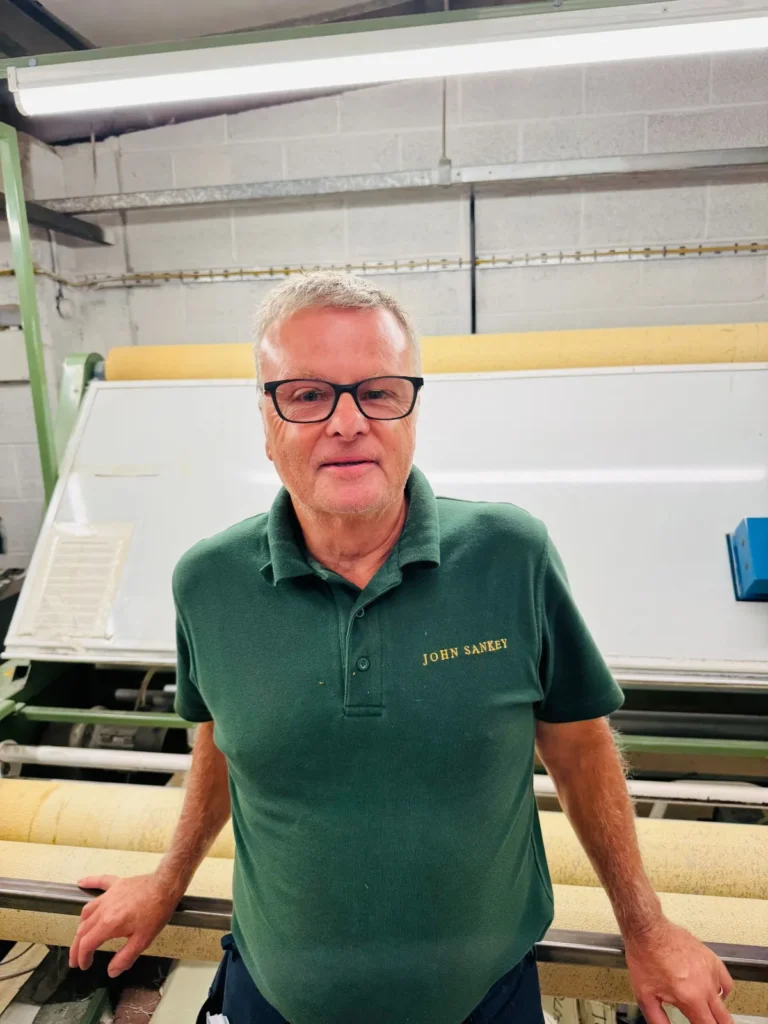
Dave has spent much of his working life around John Sankey furniture, first around the materials and preparation involved in making it and later visiting the homes of people who bought it. Sometimes he finds himself standing in front of furniture that left the factory more than a decade earlier. By then, nobody remembers which spring clip was checked or which piece of preparation was corrected before the fabric went on.
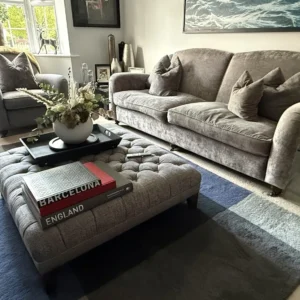
On one recent visit there were two Tolstoy sofas in a fabric Dave recognised: Soft Check Cognac. They had been there for years, long after the production decisions involved in making them had disappeared from view. The remarkable thing wasn’t that somebody had preserved them carefully. They were simply still there, being used as furniture.
Dave encounters older pieces too. Some have been in their homes for fifteen or twenty years, and their owners do not necessarily want something new when the fabric eventually needs attention. They still like the piece and it still works, so it is recovered and goes back into the same home wearing something different.
There is something rather satisfying about the distance between those two moments. In the factory, somebody makes a small decision about something another person may never know exists. Fifteen years later, that person isn’t thinking about craftsmanship at all; they are simply deciding that they would quite like to keep their sofa.
John Sankey has been making furniture in Long Eaton since 1953. That is long enough for a great many processes to be learned, repeated, questioned and passed on. Perhaps the real value of all that accumulated knowledge is not that it tells the next pair of hands exactly what to do, but that it teaches them what must still be true when they are finished.
And then there is Irina, sitting in a white suit behind a very large black dog on a traditional leather sofa.
There are several things in the photograph competing for attention. The sofa seems perfectly content to let them.
Nothing about it has become less serious because the picture refuses to behave seriously. The frame is still the frame. The preparation is still underneath. All those quiet decisions made long before anybody reached for a camera are still there, doing precisely what they were supposed to do.
Perhaps that is the freedom that knowing your traditions properly gives you. You don’t have to preserve everything around them simply to prove that you respect them.
You just need to know which things are holding the whole thing together.